NASA Lewis Research Center (LeRC) Pilots
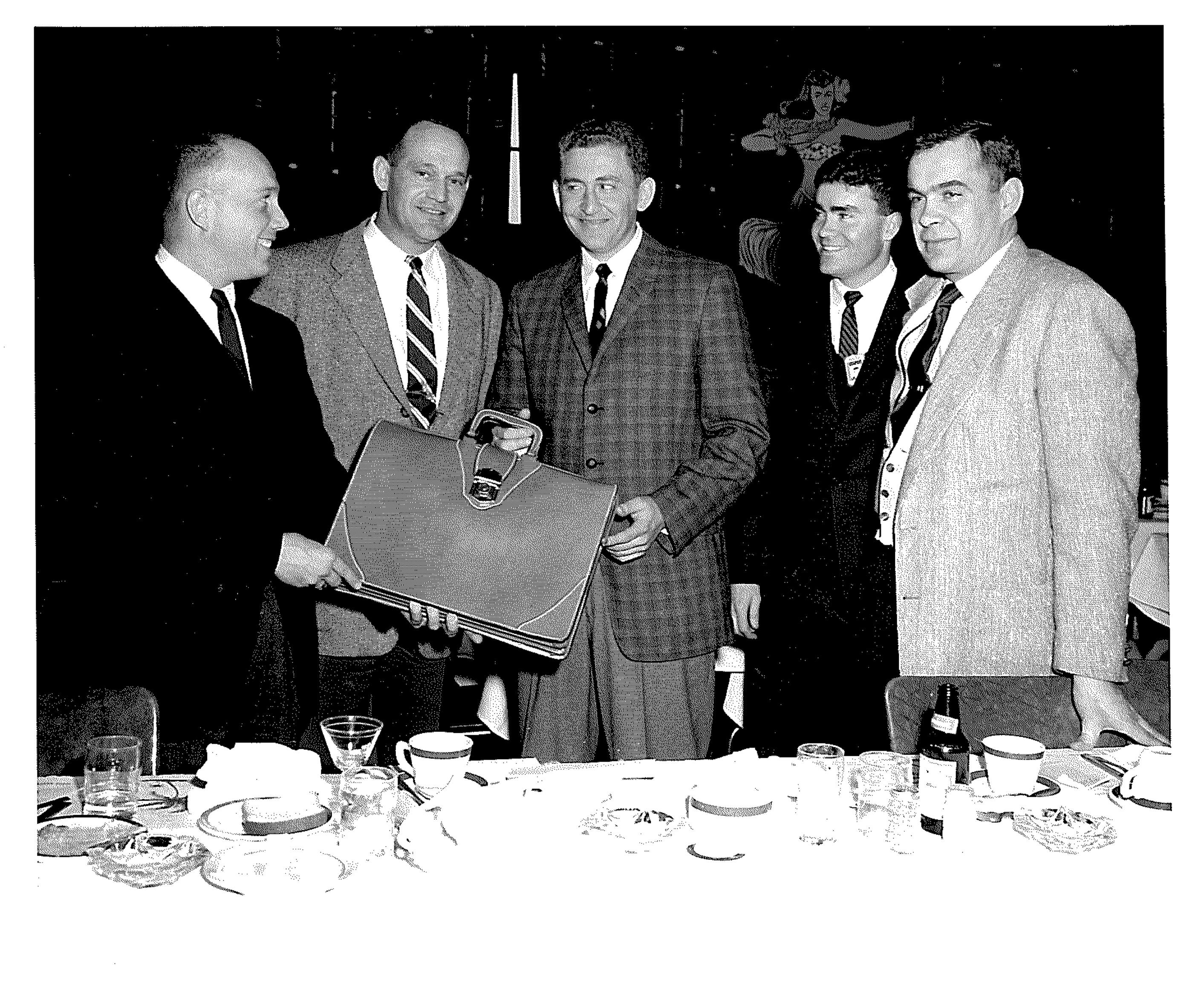
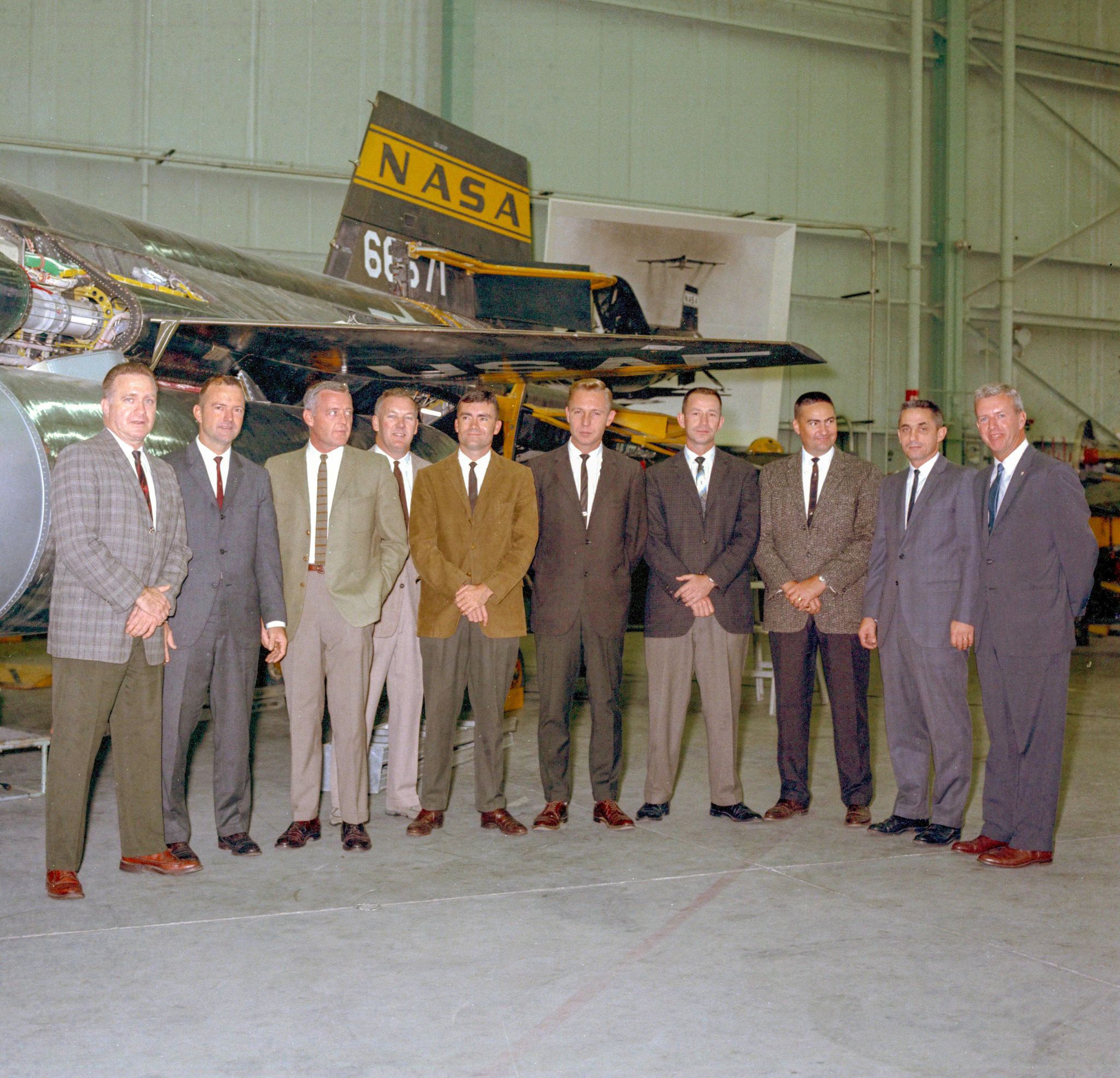
Who:(Left to Right) Jack Enders, Eb Gough, Joe Algranti, Fred Haise, Bill Swann
Download:Image (JPG)
Audio (M4A)
While still in school at the University of Oklahoma to earn an engineering degree, I was exploring my options for employment as a test pilot. My Oklahoma Air National Guard squadron Commander, Stanley Newman recommended that I apply to NACA that within a year became NASA with the announcement of the Mercury Program with the goal of putting humans in space.
More to come Summer 2022
Other than my brief visit to meet with my future boss, William V. "Eb" Gough Jr., I had never been to Lewis Research Center (LeRC) nor to Cleveland in my prior flying days. Throughout my indoctrination I was surprised at the variety of basic research projects that were going on. Other than several wind tunnels testing engines for flying vehicles, current and future, there were a number of smaller labs in the basement area of the Engineering Research Building or ERB. My next door neighbor was a technician conducting tests to provide better lubricants, ball bearings, etc. Things that were of benefit for efficiency in engines and machinery. Work was also underway on improving efficiency of Aircraft engines in wind tunnels as well as lab work to improve solar cells. Small rocket engines were being tested with live firings in the Rocky Creek area that would not have been allowed by the EPA today. I found work under Project Rover being done on the Nerva nuclear rocket engine at the auxiliary Plumbrook Facility to the west near Sandusky.
I settled into my desk overlooking a scene of the Cleveland Hopkins airport; the commercial airline terminal was directly across the field. I quickly found a source for snacks down the hallway in a vault left over from prior classified programs. An "honor" system was used for one to leave their payment. I found portable carts of snacks staged at other "old" NASA Centers that were run by handicapped people. Other than Eb, the other pilots were Bill Swann, Joe Algranti, and Jack Enders. Bud Ream had just transferred to NASA Langley Research Center and Joe Algranti soon followed him. Joe later joined the Space Task Group to head Ellington Field Flight Operations with a transfer to NASA Manned Spacecraft Center. He was responsible for the upkeep of the aircraft that I later flew as an Astronaut.
I was really looking forward to checking out the variety of aircraft that were nestled in our hangar "stable." Our ancient hangar had manual doors that had to be opened and closed using our small tug vehicle, normally used for aircraft towing. This manual door-by-door opening & closing was not a pleasant task on snowy, cold days. A great upgrade was made by taking advantage of the U.S. Navy Auxiliary Air Station at Chincoteague, Maryland that was closed to become NASA Wallops. NASA utilized the facility for rocket launches of the Aerobee, various smaller sounding rockets, and the four-stage solid Scout rocket that could carry small satellites to orbit. A great bonus was the availability of the electric drive motors on that almost new hangar. We were able to capture those from one set of doors that were not utilized to install them on our Lewis hangar.
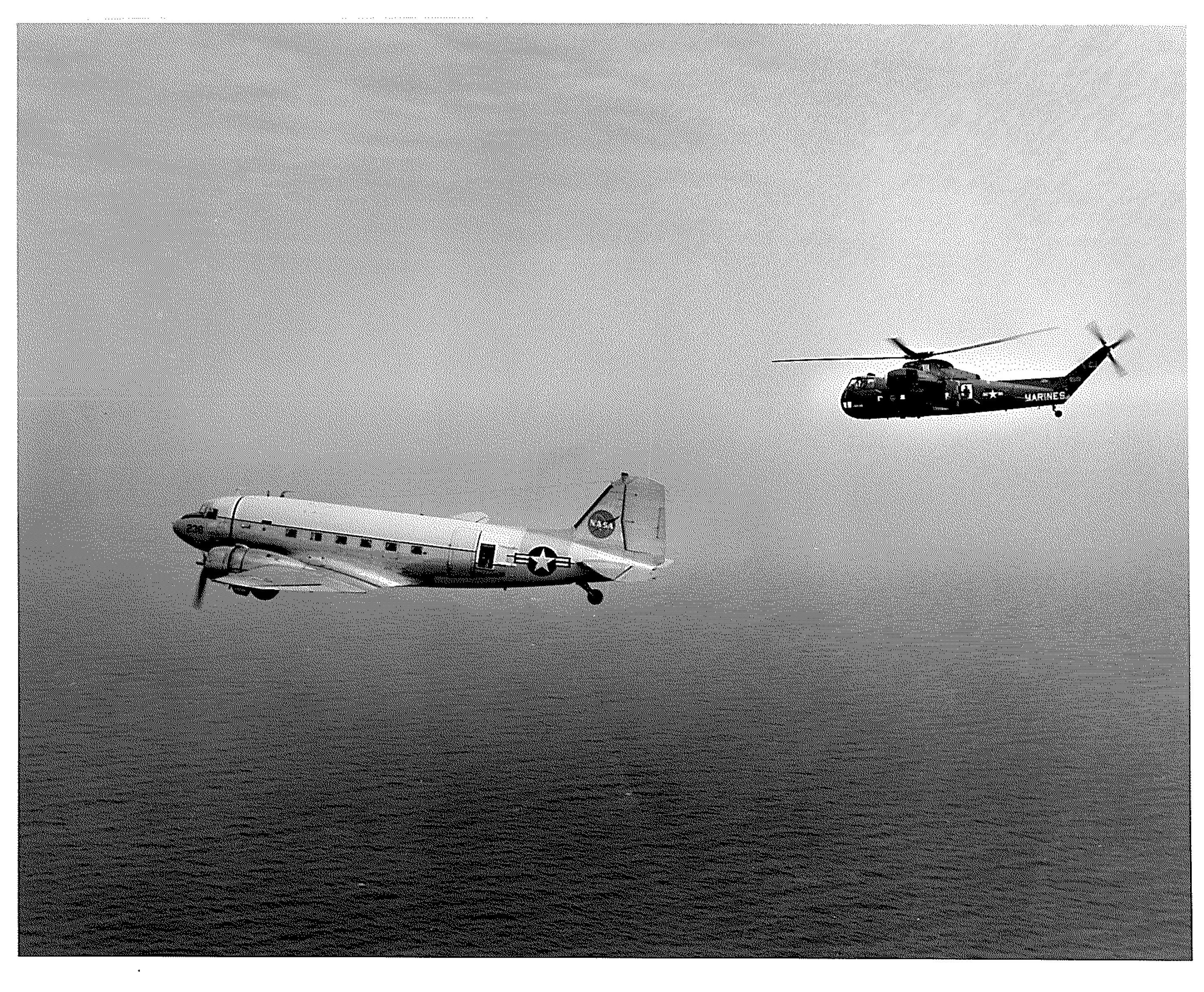
Our Navy R4D transport was the equivalent of the USAF C-47 or the commercial DC-3 but had modifications from an "icing" program with several tanks of glycol fluid added to fight icing. There was also a "U" shaped sensor with air holes just outside the copilot window that when covered with ice would trigger a light in the cockpit and a heater to melt the ice. By timing the light flashes against plotted data one could determine the buildup rate of the ice. Sliding open the side window allowed the capture of an ice specimen to observe its character and determine to what degree either "rime" or "clear" ice. Finding the latter triggered one to be aggressive to keep ahead of the ice buildup on the propellers, wing, and windshield. The copilot’s prime duty in the war against icing was to keep a sharp lookout on the leading edge of the wing, including use of a flashlight at night. Before the ice could move past the rubber boots onto the leading edge of the wings, the pneumatically inflated boots would be cycled to crack the ice off. Allowing ice to cover the wings adds weight and alters the shape of the wing airfoil to potentially cause a stall. Occasionally glycol would by flowed over the propellers accompanying with cycling the propeller RPM to hear the welcome banging of loose ice hitting against the aluminum fuselage. 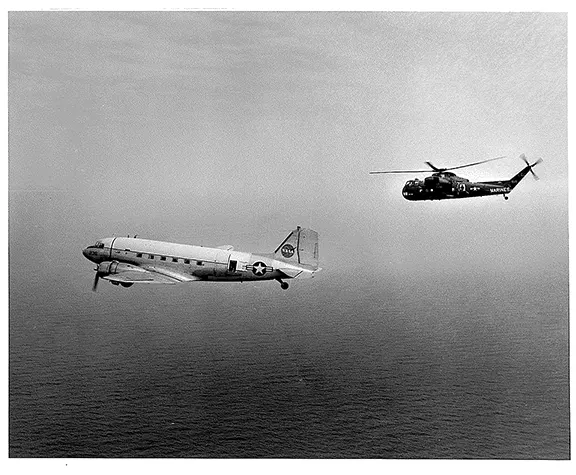 The next time that you see any of the about 5000 DC-3’S still in service, you may find a shallow dent pattern on the aircraft fuselage adjacent to the plane of the propellers rotation from ice impact. Another tactic was used to keep a clear view out the front windscreen for landing. The windshield wipers would be placed at a forty-five degree angle and glycol released. The fluid would move around in a circle to keep a "porthole" open for landing.
Passenger seating for "creature comfort" recovered from a crashed Capital Airline aircraft had been installed. Our pilot seat cushions had also been acquired that way. These upgrades supported our regular airline operation on Monday and Friday transporting Lewis employees who had transferred to the newly formed Space Task Group at NASA Langley Research Center. These ferry flights between Lewis Research Center and Langley Research Center continued until all the transferees has managed to sell their homes in Cleveland.
NASA acquires aircraft for loan from the military that are best suited for a specific test program. The F2H-2 Banshee that I observed in the hangar was very similar to those I had flown in my first U.S. Marine squadron, except it had a "special weapons" rack to carry a nuclear device. This was adapted to carry a ramjet engine on a test program. A ramjet offers the advantage of not requiring the turbine section of an engine to provide compressed air to the burner section. The disadvantage of the ramjet is that it requires one to be at a certain airspeed to provide air compression through the inlet for the engine to start ignition. The testing program ended when on a flight by Joe Algranti, the ramjet separated from the Banshee and fell into Lake Erie.
I enjoyed flying the two B-57’s Canberra’s for their roomy cockpits (compared to a fighter) and the ability to achieve altitudes above 45,000 feet with their large wing area. The cockpit configurations between our two Canberra’s were different. The "A" model had a small bubble canopy for the pilot and provisions for a second crewman seated in a lower station below just inside the side hatch. Only the pilot seat was equipped with an ejection seat. The second crewman had to escape by opening the hatch door to provide a wind screen for his manual bailout. As a result, I flew this aircraft solo most of the time as there were no volunteers to fly as second class citizens without an ejection seat available. Our B-57A was the first prototype aircraft built in the United States by the Martin Company under license to England and had one nice modification. The normal single engine minimum speed for the operational Canberra aircraft controllability is 140 knots. If below 140 knots on takeoff and an engine is lost, a crash landing or ejection is soon to follow. With the added rudder boost, the minimum control speed on our "A" model was lowered to 115 knots. On September 6, 1962 I flew the B-57A non-stop to Davis-Monthan AFB in Phoenix, Arizona to the boneyard. I hoped it would be put on display at the Pima Air & Space Museum located adjacent to the AFB.
Our sister B-57B aircraft had a tandem seat arrangement with ejection seats provided for both crewmen. Both Canberra’s were used to support several programs to take advantage of the high altitude capability. For example, Bill Swann flew a mission with the B-57A aircraft to launch a two-stage rocket, headed east to the Atlantic Ocean after passing over NASA Wallops that achieved Mach 8. One program involved testing advanced solar cells that were mounted at the base of a black tube to focus the sunlight. This work would, for example, support the Solar Electric Propulsion or SEP Project and the Solar Probe Plus. Other flights were flown to collect samples in the jet stream from the Russian nuclear bomb testing in the early 1960’s.
Jack Enders and I were assigned to the startup of an aircraft Zero-G Program that was the second one in the country. Several aircraft were evaluated that possessed a bomb bay area suitable to free float fluid test specimens. We evaluated the Douglas USAF B-66 and Navy A-3 before settling on the North American Navy AJ-2 Savage. The Navy was replacing the AJ-2 in the fleet with the A-3 aircraft. This assured us a supply of spare parts and even access to major AJ aircraft components from the aircraft put in storage at NAS Litchfield Park in Phoenix.  The AJ-2 was equipped with three engines. Two reciprocating Pratt & Whitney R-2800 engines, provided 2,300 horsepower each. A single Allison J33 turbojet engine was buried in the aft fuselage section with its intake on top of the fuselage. It was a "stealth" engine. Meetings were held with the USAF team at Wright Patterson AFB with the first Zero-G program in the country to conduct tests with human subjects. Primary discussions focused on problems and modifications found necessary on their twin engine, reciprocating engine transport aircraft. One major one was the fix to assure oil supplied to the engines to prevent damage. Other aircraft systems involving fluids were evaluated, namely the fuel system, jet engine lubrication, flight control hydraulic boost and the propeller governing system. All were found adequate without modification for the short time of the trajectories flown that provided about 20 seconds of good zero gravity. We also met with personnel at the North American Aviation facility at Columbus, Ohio that were operating an AJ-1 as their electronics test bed. An agreement was made for mutual support with spare parts and technical consultation to keep our test aircraft flying.
The normal gyro horizon, along with the added acceleration readouts in three axes, and a TV monitor covering the action in the 5 x 5 x13 ft. bomb bay were centralized in the instrument panel providing key aids to the pilot. The accelerometers provided readings at the center of the payload bay. We found it was best to live with the initial aircraft trim setting throughout the maneuver to assure the control forces to be dealt with remained in the same direction. This became tiring after a number of trajectories so Jack and I would shift positions from pilot to payload bay attendant. We often flew one of our mechanics or the crew chief and with a little training they would play a role. Their job was to keep the needle centered on the longitudinal acceleration instrument by adjusting the engine throttles. Our operating area was in a Restricted Area at the west end of Lake Erie that was operated by the Army for artillery training. A large circular device with numbers was placed at the forward end of the payload bay wall that had been added. The needle would be moved up a number so each run could be correlated with the recorded video. The added wall provided a shelter for the payload bay attendant to hide behind when we flew some of the larger and heavier free-floating experiments. One very large experiment, the SNAP-8 cooling system was strapped down. This experiment had a carbon heat source versus a nuclear core. But the cooling system that was being evaluated involved the materials sodium and mercury, so it was hopeful that we would never suffer a leak. Other testing with liquid hydrogen, among other findings, supported the design of the screens in the Centaur rocket propellant tanks to preclude the need for an ullage burn to start the rocket engine.
As an example of NASA Center teaming, Bill Swann supported the Mars Viking Program at Langley Research Center for one mission, borrowing the AJ-2 that provided a suitable bomb bay area. A prototype package with the planned Viking control system was dropped from the AJ-2 as it just passed the Wallops tracking station to collect data for evaluation.
After I had left LeRC for NASA Flight Research Center (now Armstrong Flight Research Center) a fire had developed during a liquid hydrogen fill of the sphere in the AJ-2 payload bay. When hydrogen is burning there is no visible flame. The first thing that the ground personnel noted was paint peeling off the side of the fuselage and eventually the center structure failing with the aircraft slumping to the ground in the center section. The fire was controlled to prevent an explosion but the aircraft was a complete loss.
Other than our aircraft and aerobee rocket testing. Lewis had a third Zero-G program underway. A 510 foot shaft was created through the underlying rock strata. This allowed an experiment package to free fall and achieved seconds of pure Zero-G. As with the other programs, the experiments focused on fluid system components.
In conjunction with the move after College graduation to join NASA at LeRC, I arranged a transfer to the Ohio ANG unit at Mansfield, Ohio. The 164th Tactical Fighter Squadron was equipped with the Republic Aircraft Company F-84F fighter/bomber aircraft. The aircraft also had the nickname of the "Super Hog." With the symmetrical airfoil it was the first fighter that I flew requiring line speed checks going down the runway, like Strategic Air Command (SAC) bombers normally did. If the proper speed was not met, it indicated that you would not be able to lift off by the end of the runway. The procedure was to jettison the two fuel drop tanks, either 230 gallons or 460 gallons capacity. This immediately reduced the weight to allow a safe takeoff. The hope was that the dropped wing tanks would not bounce off the runway and hit the tail section of the aircraft. The wing also did not provide for great maneuverability compared to other fighters of that vintage. It did enjoy a capability of being able to sustain a 3-g pushover, whereas most aircraft were structurally limited to 1-g negative. The aircraft was designed to be an escort for SAC bombers so it had tremendous range with the 450-gallon drop tanks. It also had air refueling capability that was compatible with the SAC fueling tankers’ boom probe. On my first air refueling flight I hoped that the controller of the boom in the tanker was good, as the probe was inserted into the refueling receptacle in the left wing only a few feet from the cockpit. The F-84F aircraft was equipped with six 50 caliber machine guns and wing racks for bombs and rockets. It also was equipped with the Low Altitude Bombing System (LABS) to deliver a nuclear weapon.
In September 1961 the 121st Tactical Fighter Wing of the Ohio Air National Guard was called up for active duty with the USAF Tactical Air Command during what was called the "second Berlin crisis." Our unit, the 164th Tactical Fighter Squadron at Mansfield, Ohio stayed in place while our sister Columbus 166th unit was deployed to Etain-Rouvres Air Base in France. Weapons training was done at the Indiana Atterbury weapons range or on deployments to Volk Field, Wisconsin as well as out of Hunter AFB at Savannah, Georgia, using an Atlantic Ocean Warning Areas.  We also practiced "toss bombing" or the technique of delivering a nuclear weapon from a low level approach across West Virginia to the Atterbury range. Going over a more desolate area of West Virginia, I wondered what "moon shiners" thought of these aircraft flying at 500 foot altitude or less. When turning north toward the range for the final approach to the target, power was set at maximum. This would achieve a speed over 500 knots for the 4G to 5G pull up approaching the target. The practice weapon would be released when essentially vertical to allow it to continue upward while providing time for the F-84F to finish a "Cuban 8" maneuver before leveling off again on the deck at 500 feet or less to escape the blast if deploying a real weapon. As a training exercise I planned a low level mission in Europe to deliver a weapon on an Eastern Block city. I was sure that my cohorts who had deployed to Europe within striking range were much more intent on target planning as well as all other active duty Strategic Forces, including Air Force fighter squadrons deployed.
Other than a designated Flight Leader, my primary role in the squadron was as a Tactical Evaluation Officer. My task was to perform evaluation of the squadron pilots for their combat readiness. Some evaluations were done in flight from a wing position, keeping notes on a standard set of cards covering the flight tasks. Being right-handed, I learned to become somewhat proficient handling the control stick with my left hand while scribbling notes. Our maintenance people salvaged the cockpit from a crashed aircraft to utilize for training in a corner of our hangar. I would randomly intercept a pilot to put them into the cockpit for a "no notice" evaluation of their knowledge, particularly emergency procedures. I had to be stealthy, as word had gotten out and pilots found devious ways to avoid my intercept on their way to/from the chow hall by the hangar.
I flew an F-84F on a "labeled" navigation training flight to Ellington Field visiting Joe Algranti and Warren North from old Lewis days to see how things were with the development of the Manned Spacecraft Center which is now Johnson Space Center. Warren was located in an apartment complex and Joe had an office in a hangar at Ellington AFB. Chris Kraft and his team were camped out in what looked like an abandoned store along Highway 45, also known as the Gulf Freeway. Joe ran the NASA flight operation at Ellington maintaining the F-102 and T-33 aircraft used by the original seven Astronauts. There were plans to upgrade to the T-38 aircraft for Astronaut proficiency with a second Astronaut selection underway. Looking to the future they both advised that when possible I should move on to a position at the Flight Research Center at Edwards AFB, California which at the time was the premier flight test operation for NASA. The opportunity came on during a November 1962 trip to NASA FRC where I spoke to Joe Walker, chief pilot at Armstrong Research Center, and was advised that a pilot opening was available. I spoke to my supervisor Eb Gough on my return and expressed my desire to transfer.
With family I had planned a leisurely auto trip to Lancaster, California that was to be our future home for several years. Our planned stops at Meteor Crater and Grand Canyon were derailed in Oklahoma where we visited with old friends and classmates from the University of Oklahoma days. My daughter, Mary Margaret, was riding a bike that was too large for her. That resulted in her slipping off the foot pedals and striking her nose on the handlebars center post when she ran into the street curb. Mary Margaret had face swelling, two black eyes, and possibly a broken nose … Never Panic Early. We were now on Plan B to drive our 1954 Chevrolet as quickly as we could to California and check in with a new doctor in our new home.
Most of our route was along the historic Route 66/Interstate 40 to Barstow, California. We then diverted on Highway 58 that led us to Boron and across the north side of Edwards AFB to Mojave. As I caught sight of Leuman Ridge with the rocket test sites on the east side of Rogers Lakebed and the lakebed itself, I was on a high. This struck me as such a great place for a flight test facility. Lots of desolate countryside where one could jump out of an airplane almost anywhere with no worry of injuring people or damaging property. I am not a pessimist, but it is nice if one had to leave an aircraft to not have to consider anything but escaping successfully.
A local doctor visit confirmed that Mary Margaret did suffer a broken nose. They put cloth tubes in her nostrils to hold the alignment while it healed. I know that it bothered her having to enter school with that condition and blackening still around her eyes; however, she weathered it well despite the hazing she encountered. In fact, her primary added burden in school was to protect her brother Fred who was being hazed by a neighborhood girl.  Within six months we purchased a home, our first, at 44561 Leatherwood Avenue. Milt Thompson, a fellow NASA pilot, was on the next street in a home just over our back fence. A pilot for Lockheed lived in a home on a crossing street. I recall hearing that he had died but it wasn’t until later that I found out he had been killed flying the A-12 or SR-71 Blackbird.
The Antelope Valley includes the cities of Lancaster, Palmdale, Rosamond and Mojave. Rosamond is the site of an abandoned Gold mine. Mojave airport is where a number of transport aircraft are preserved and today supports Virgin Galactic and the Scaled Composites Model 351 Stratolaunch or ROC aircraft operations. The Antelope Valley has a variety of vegetation that I had not seen before, including the impressive Joshua tree with Joshua Tree National Park nearby. A unique happening in the valley is that with sufficient rain during the winter and early spring a beautiful crop of poppies magically appears. Also visible on the horizon are the San Jacinto and Tehachapi mountains. Plant 42 in Palmdale has major Company facilities that have supported the production of the Lockheed 1011, B-1 bomber, Space Shuttle Orbiter, B-2 bomber, U-2, SR-71 Blackbird, F-117 Nighthawk and Global Hawk drone. Several years later I returned as an Astronaut to spend many days at the Rockwell plant for the manufacturing and testing of the Space Shuttle Enterprise in 1976 and 1977.
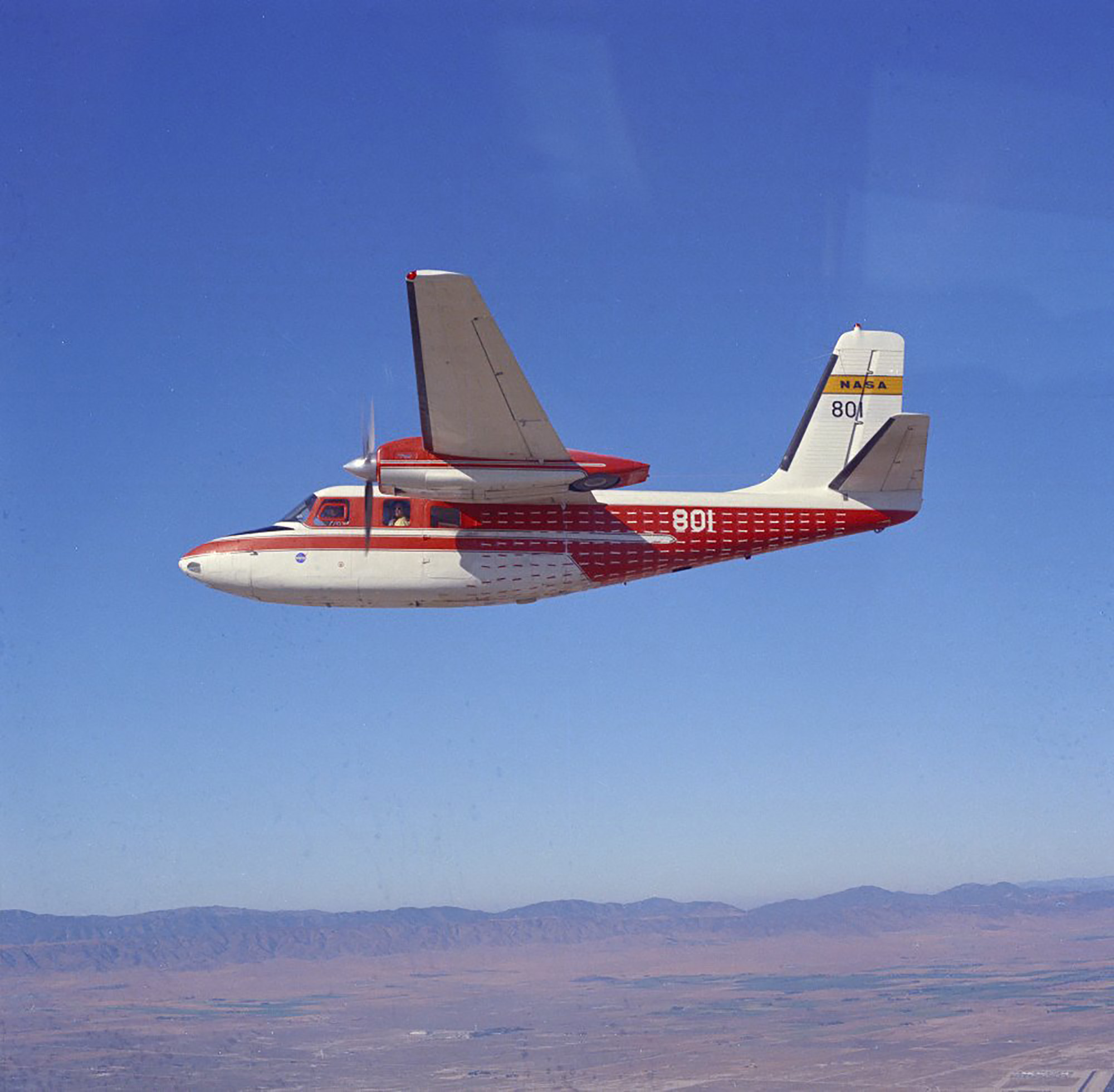
Arriving at the FRC Pilot’s office I had a great view out the window looking out over the Rogers Lakebed and down a long taxiway leading to the main Edwards AFB concrete runways. A line of hangars supported various aircraft test operations of the newer aircraft and the last group of hangars housed the aircraft utilized by the Aerospace Research Pilot School near Base Operations. NASA at the very end of hangar row had a ramp allowing one to taxi directly onto the lakebed that could be utilized for takeoff and landing of our C-47 and Aero Commander 680F, avoiding the long taxi to the main Edwards runway. There was another facility isolated to the north of NASA that supported U-2 operations.
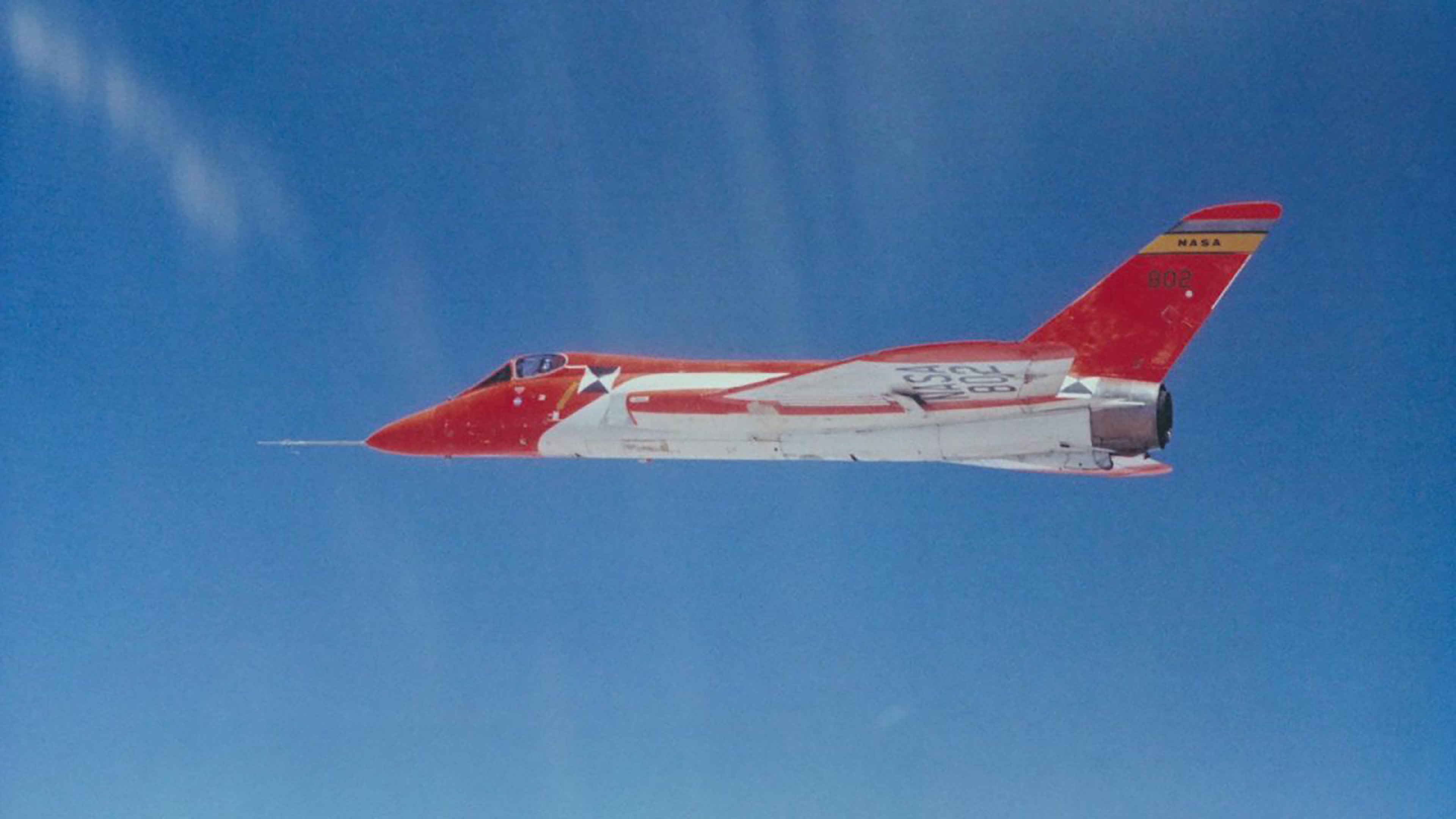
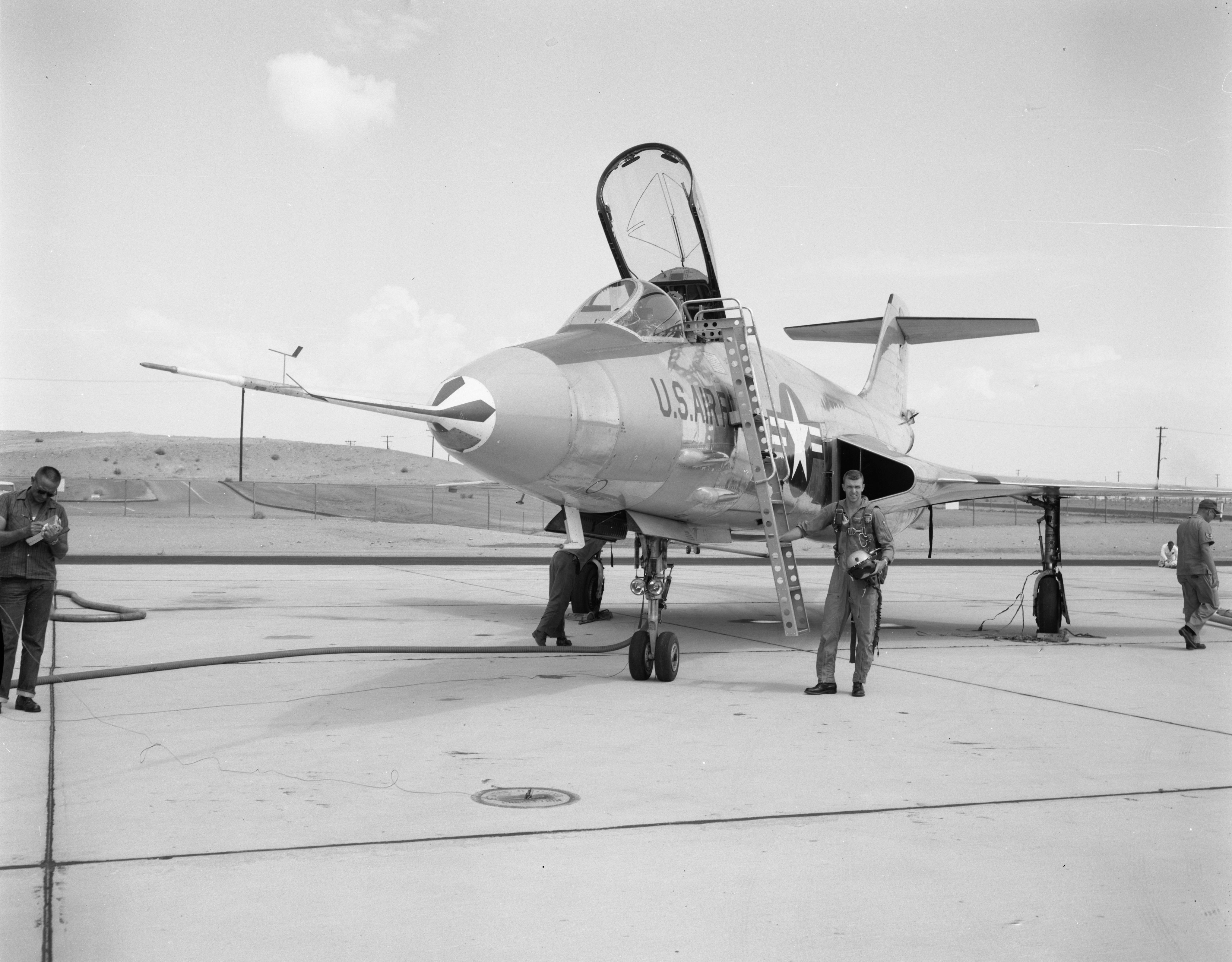
By the end of April, my first full month at Armstrong, I had checkouts in the C-47, Aero Commander 680F, T-33, T-37, and F5D. On the aircraft having dual crew positions, I was accompanied by Bill Dana or Bruce Peterson for the checkouts. The single seat F5D was a prototype aircraft built by Douglas to compete for a Navy contract vying against the Vought F8U Crusader. The Crusader won the competition and NASA acquired two of the Douglas F5D prototypes. One was at Ames Research Center and the other at FRC. Being a single seat fighter my checkout was similar to the ones I had accomplished at Glenn. I reviewed the handbook thoroughly and spent a number of hours sitting in the cockpit going through normal and emergency procedures. When I felt ready, a checkout flight was scheduled and with Bill or Bruce standing on the ladder I went through the engine start and pre-taxi checks. The office radio was set to NASA frequency should I need help while airborne. The F5D aircraft was a beautiful delta wing fighter with a Pratt Whitney J-58 turbojet engine. If the aircraft had gone to production, it was to be fitted with a more powerful Pratt and Whitney J-75. Our FRC bird was installed with the X-15 avionics equipment to provide a telemetry stream for testing the up-range tracking stations at Beatty and Ely, Nevada. I found that the aircraft when light weight, with the fuel low had almost "super cruise" capability with the J-58 engine at military power level. Starting at Mach 1.5, the aircraft would hold supersonic almost all the way back from Ely without afterburner. A drawback as a fighter was the very narrow canopy that limited all around visibility.
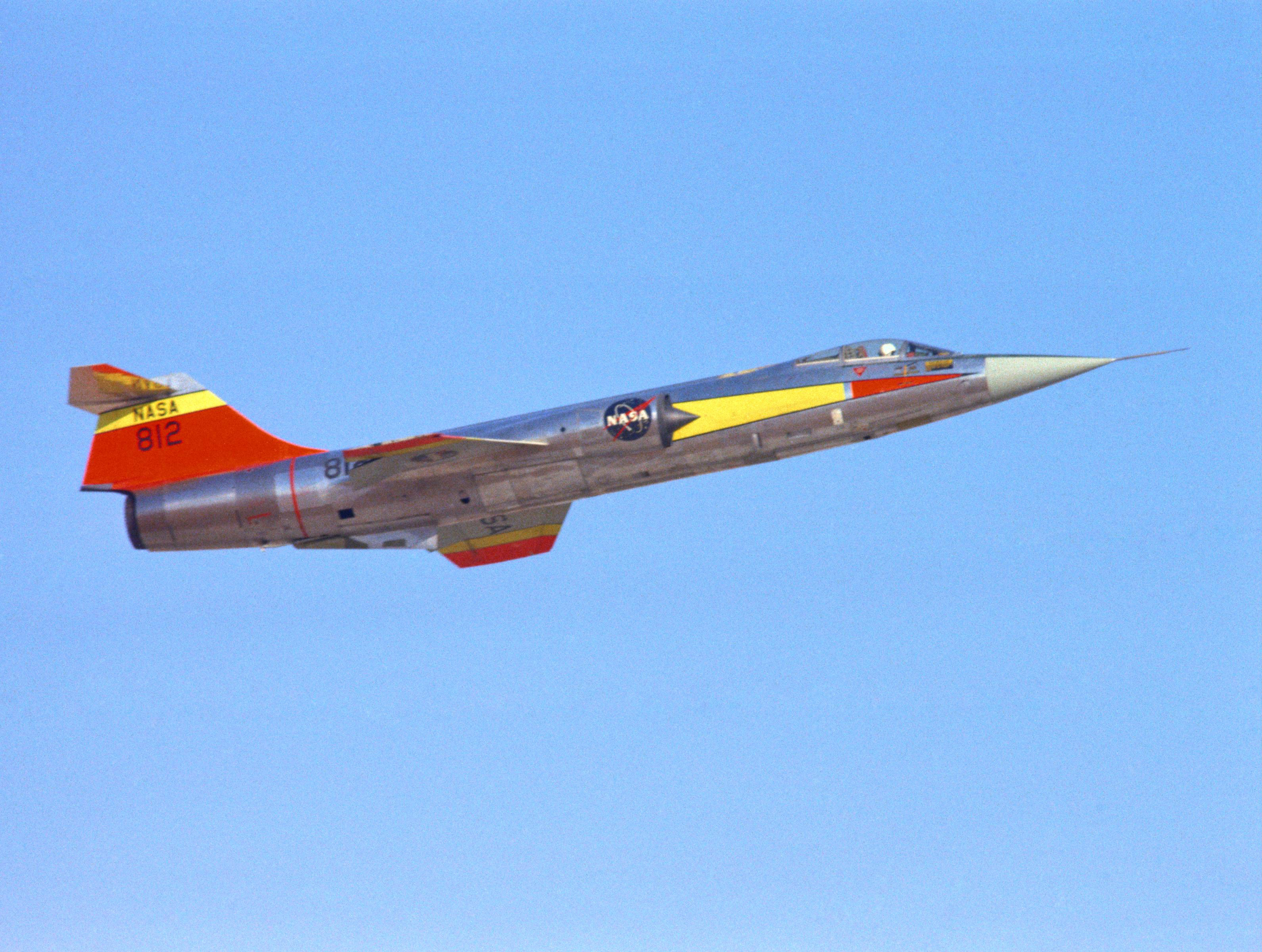
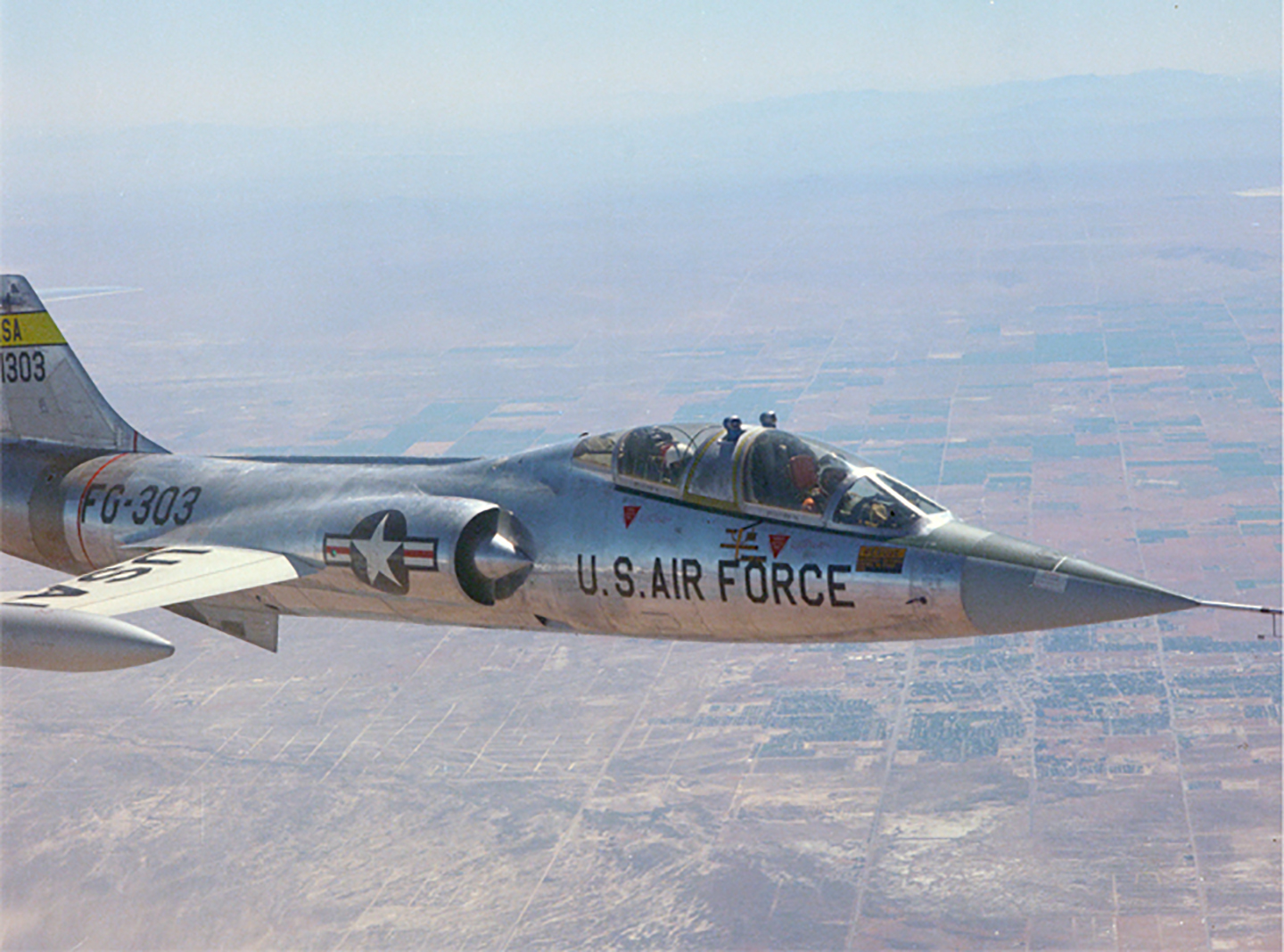
My first Lockheed F-104 flight was on May 23 with Bruce Peterson. The F-104 Starfighter looked supersonic sitting on the ramp. It was the first aircraft where I saw the Mach meter reach 2.0 and I received a card to that effect from Lockheed. The aircraft had short wings with a sharp leading edge that dictated protective gloves be installed to preclude anyone from walking into the wing and being injured. That short wingspan resulted in a poor turning radius for a fighter … but it could go fast! 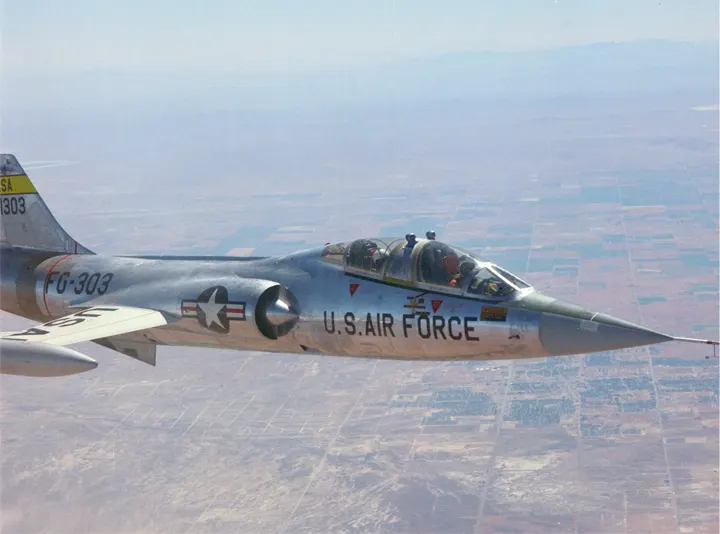 The aircraft had augmentation with rate dampers in all three axes. The first time I turned them off, the need was apparent as that aircraft wobbled around in all axes. A nice performance capability of the aircraft was that with the right configuration set, it would duplicate the L/D (lift to drag) or glide performance of the X-15. Although the handling qualities did not replicate that of the X-15, it provided the ability to practice approaches to the lakebed for proficiency of the flight path before an upcoming mission. With the aircraft fully "dirty" with full flaps, speed brakes and idle power, it approximated the even lower L/D of the later Lifting Body vehicles.
I flew a variety of flights supporting X-15 operations. For example flying the F5D to checkout telemetry with the tracking stations, flying hydraulic samples after auxiliary power unit runs in the C-47A to the North American plant at LAX or Los Angeles airport for lab testing, doing launch and alternate lakebed checks and on the day of the X-15 launch fly weather or chase flights in the F-104. Our C-47A was the aircraft of choice for lakebed checks with its large tire footprint. We would land and continue rolling down the runway with the copilot watching out the window. If no tire settling into the lakebed was observed the aircraft was either stopped or a go around effected to then make a full-stop landing. A small motorcycle was unloaded and we proceeded to test the runway integrity. The test equipment consisted of a steel ball attached to a chain and handle. It would be raised to shoulder height and dropped to check the impression made up and down the length of the lakebed runway. Similarly at each stop a metal spike was driven into the lakebed with a small sledge hammer to about a foot depth to check for dampness below the surface that looked dry.
Other opportunities came up from time to time to take part in other test programs. For example, I flew with Stan Butchart in the JetStar General Purpose Airborne Simulator. The aircraft through computers provided "variable stability" to have the aircraft resemble flight characteristics of other aircraft. I had flown the JetStar, among a number of other aircraft, while at Lewis Research Center in a study led by Joe Algranti to select a new transport aircraft for NASA. The G-1 Gulfstream was ultimately chosen. I flew with Bill Dana in a Navy A5A evaluating simulated supersonic transport approaches into Los Angeles International. These flights were in conjunction with the FAA to evaluate traffic control handling of the British and French Concorde supersonic transport aircraft. And there also came those unexpected joys when once while flying the T-37B, I had the opportunity to dogfight with a Navy T-28B out of NAS China Lake. I knew the aircraft was from China Lake because the insignia was easy to read when I had him in my twelve o’clock at a couple of hundred feet.
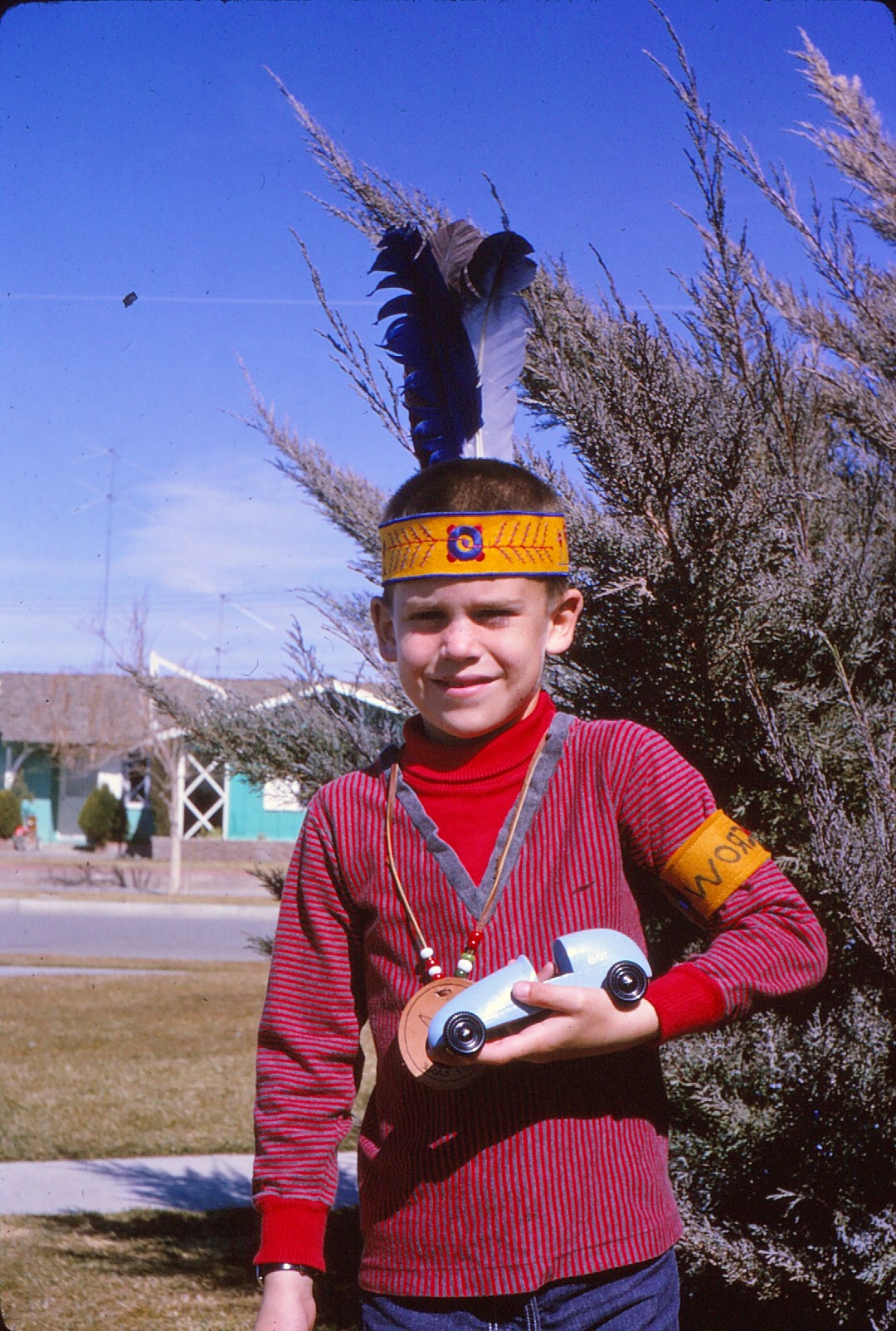
I had some great activity with my son Fred when we joined the "Indian Guides" program. We enjoyed both the meetings and the outings. At the meetings one of the standard activities was to have all sitting in a circle with a large cow bone passed around. When you held the cow bone you were obligated to cite your name and tell a story. 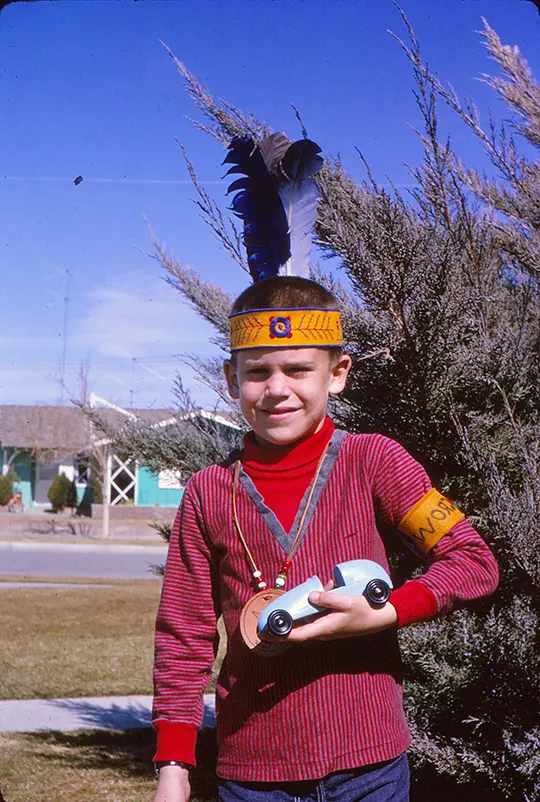 I think this was a help to Fred who was very shy. One outing our group planned was a trip to Death Valley. Since it was an extra special outing with an overnight planned, it was opened up to other family members. My daughter Mary Margaret and youngest son Steve came along. It was a really great outing, with sleeping bags among the sand dunes below sea level, surrounded by mountains. Away from city lights the star field was incredible with the Milky Way clearly visible. There was a Never Panic Early incident on the way home with the brief loss of my son Steve. We had stopped at a filling station and after leaving (and several miles down the road) one of the children cried out, "where’s Steve." We went back to the filling station and thankfully found him behind the station still happily throwing rocks at tin can targets!
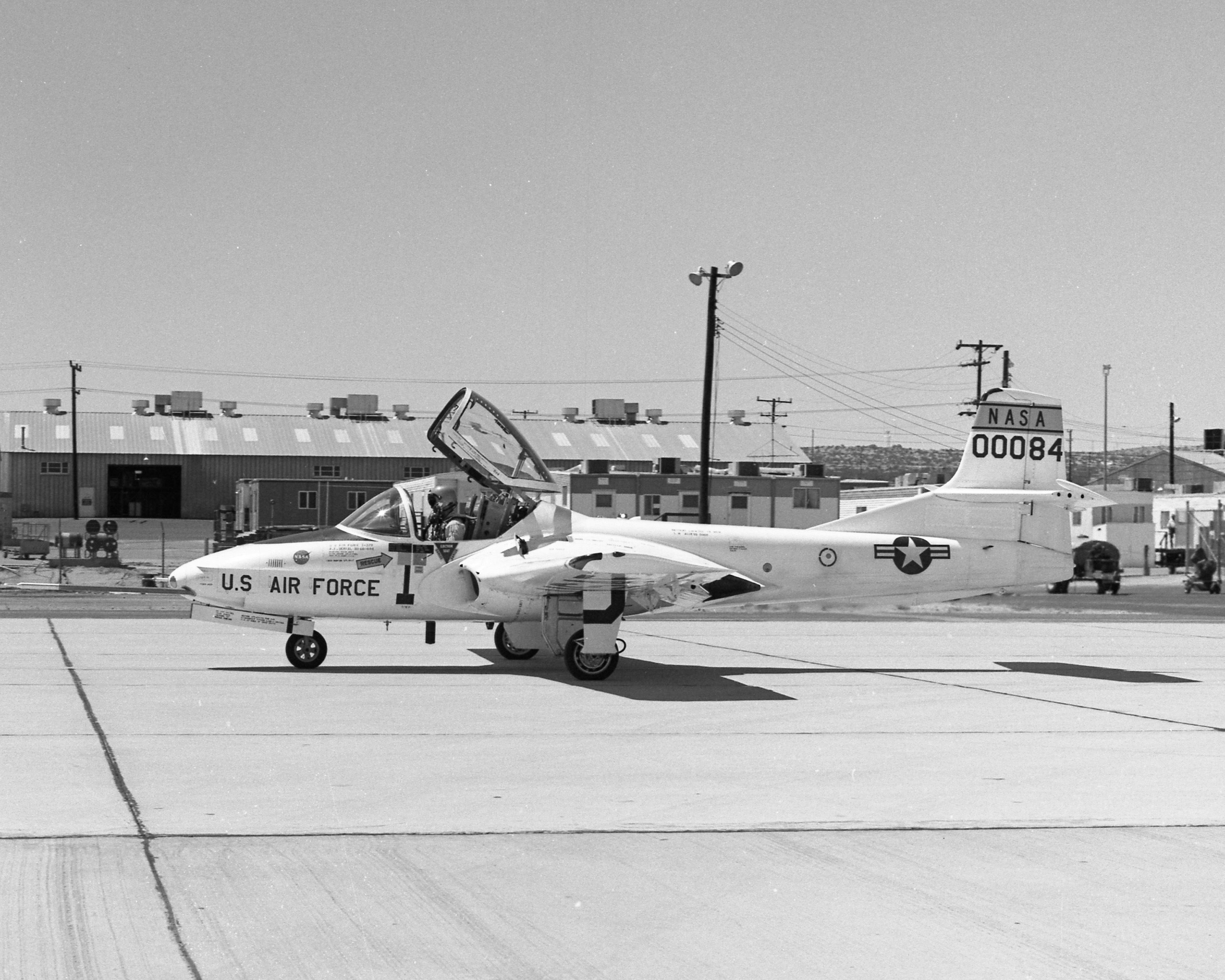
Bruce Peterson, after joining the pilot’s office at FRC, had been assigned to go through the six-month test pilot portion course at the Aerospace Research Pilot School or ARPS. Similarly Don Mallick and I were assigned to join 16 students in Class 64A at ARPS. All were U.S. Air Force or U.S. Navy pilots except Flight Lt. Harry Wilkinson, Royal Canadian Air Force and Jaap Hostra, Royal Netherlands Air Force, Belgium, who were foreign students. Just after New Year’s Day I moved my flight equipment to the ARPS building close by Base Operations. On January 3rd, two days after moving down the ramp from FRC, I made my first flight at ARPS in a T-38A with Swang Rasmussen, a foreign student. The T-38 did not have roll limiting and I had my first exposure to the dynamics of inertia roll coupling. That was a characteristic found in the X-3 Stiletto aircraft. We experienced "g" excursions from +5 g to -1g but no damage to the aircraft, a memorable beginning at ARPS. I think Swang made the full deflection roll control input to impress the "new" guy.
Our classroom knowledge was extended into reality with actual test flights in selected aircraft that were chosen to highlight handling quality or performance characteristics. This activity was followed with the analysis of data collected via photo panel or oscillograph and our generation of a written report. The analysis of the data was tedious and I think impressed upon you the importance of being smooth and careful in flying the aircraft to make for less scatter of the data. Ernie Hasselbrink and I flew together to collect Stability & Control data on the T-33A at various center of gravity loadings. As we plotted the data collected on three curves for forward, mid, and aft center of gravity, we noted one data point way off the line. 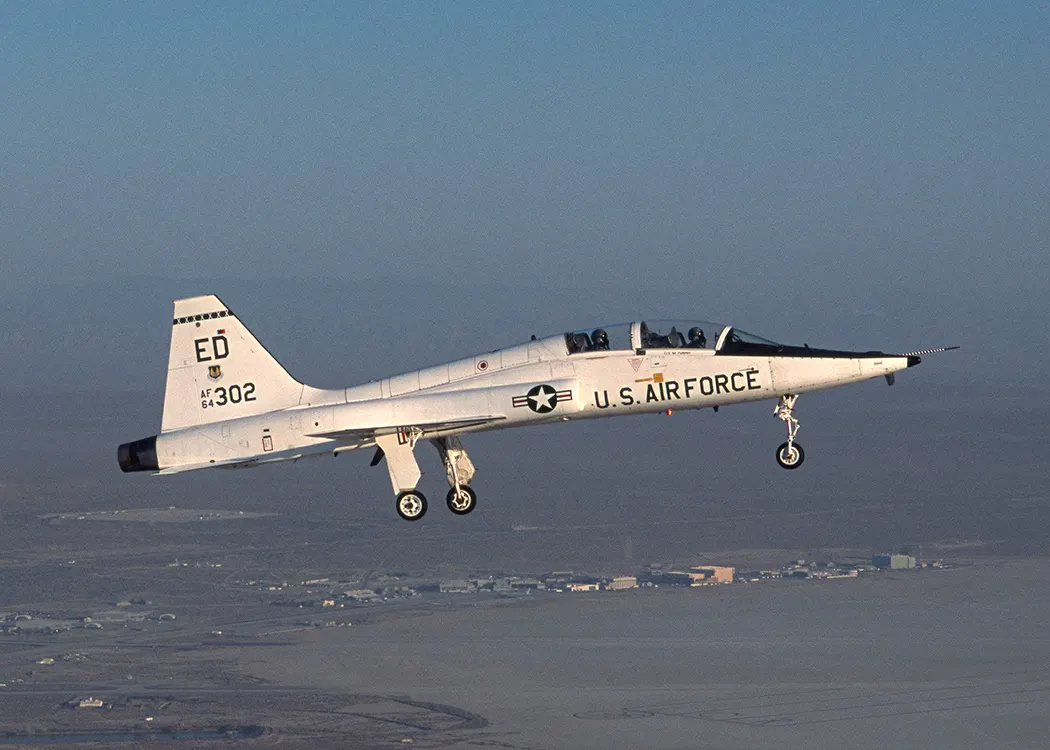 It was important as speed was increased through a data run not to reverse the stick force by trimming or changing control stick pressure from "push" to "pull." Ernie thought of a clever way to handle the anomaly. On the graph there was a legend with different symbols like a circle, square, and triangle for the data points on each different center of gravity curve presented. Following Ernie’s clever advice, the data point "out in left field" became one of the legend symbols!
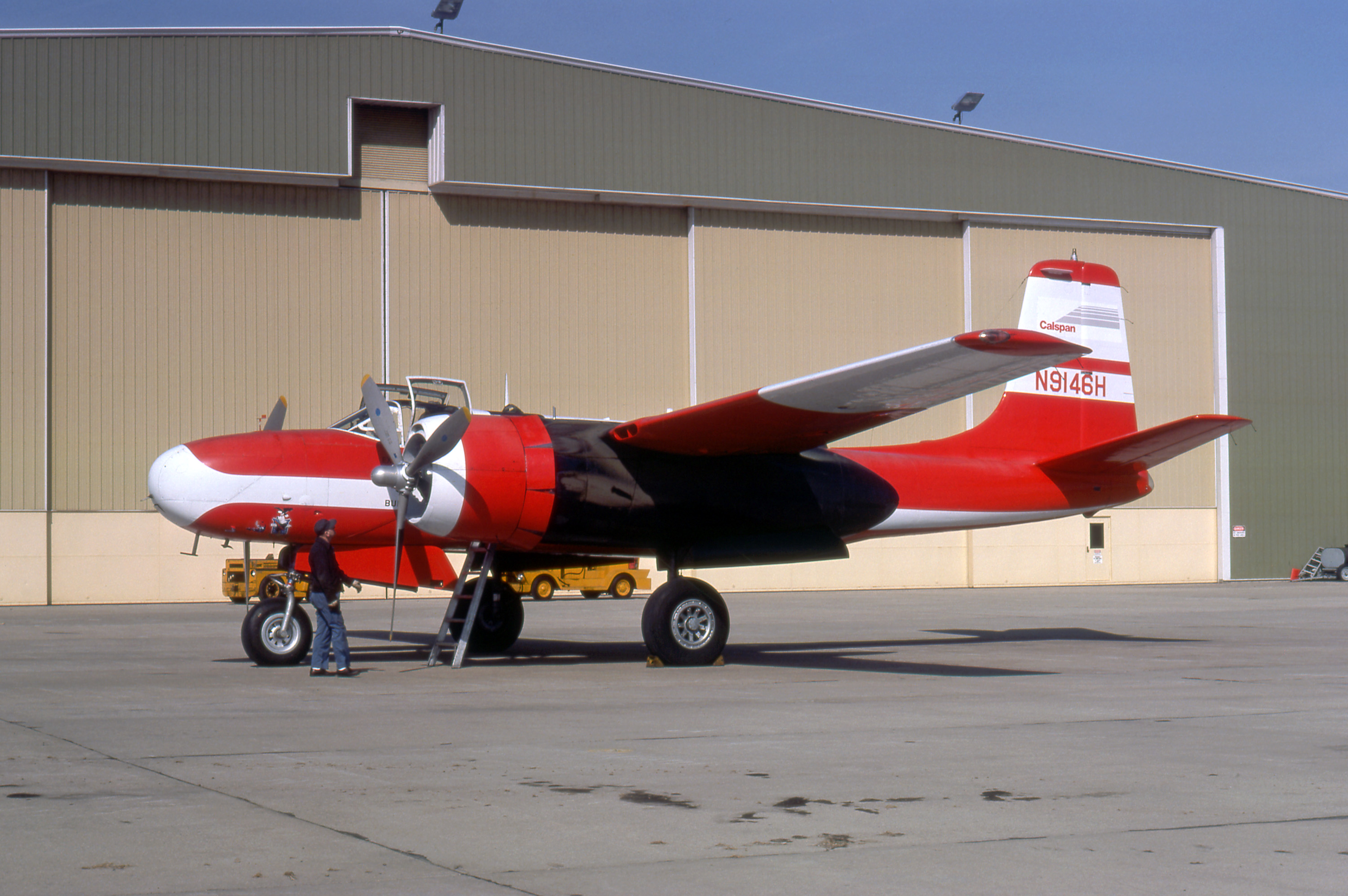
The B-57B was introduced in the third month for stall and single engine testing. The T-33 was utilized in the fifth month to evaluate going into and recovering from spins with different aircraft configurations. Some spins were entered by simply slowing up without turning. Other tests were made while maneuvering through an accelerated turn, pulling g’s. Each spin was documented with photo panel film as well as the pilot calling out the key parameters of pitch and roll attitude with airspeed and altitude during each rotation or 360 degrees of the spin. You had to keep your mind on the aircraft motion at hand and not think about the execution of recovery controls to come out of the spin. We were given several flights in the Calspan B-26 variable stability aircraft in May and June. Bob Harper the instructor pilot would set the conditions to allow evaluating a broad range of handling qualities. It was great "hands on" experience to fly a virtual aircraft with varied stability and dynamics. This offered a safe way to evaluate very low stability handling quality where the instructor pilot could revert back to the basic B-26 with the push of a button.
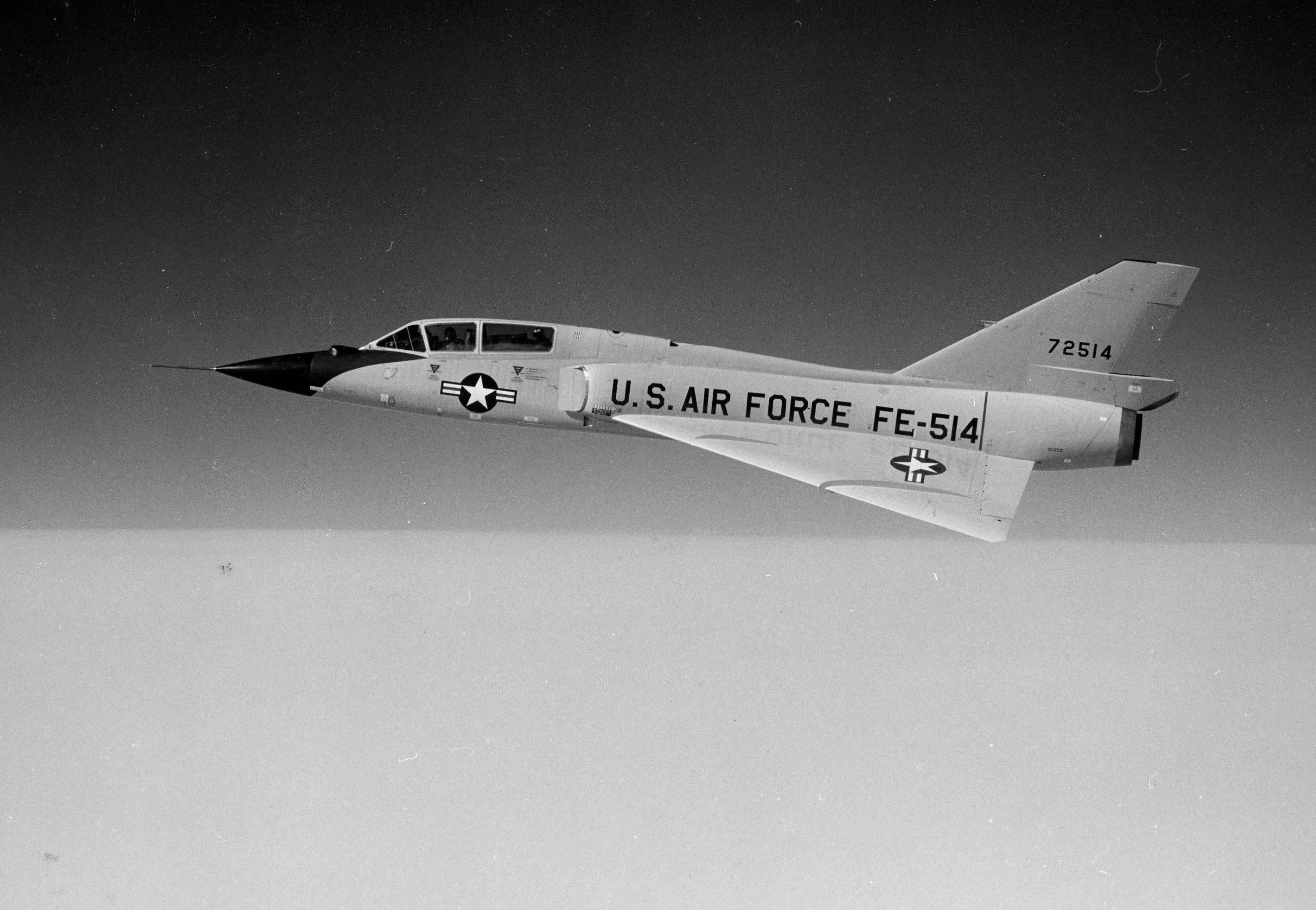
June, the last month of the Test Pilot School portion of the program, included a qualitative handling qualities flight in the F-106B Delta Dart. This aircraft was a Mach 2.0 interceptor with a large delta wing. Like the NASA F5D it had a narrow cockpit canopy that provided poor rear visibility. I arranged to schedule the NASA F5D on the day that my 64A classmate Jack Finley was flying the F-106A. We joined up north of Edwards when Jack had about 2500 lbs. of fuel remaining and proceeded to evaluate the relative turning performance with a "dog fight." I was surprised to find that they were very close. I suspect our F5D with a J57 engine would have won with the planned larger J75 production engine.
Our flying progression involved a number of aircraft with the primary tool being the F-104. During my first month at ARPS I flew 24 sorties with half being in Starfighter. Near the end of the year I had a number of flights in the single seat, variable stability McDonnell NF-101A Voodoo. 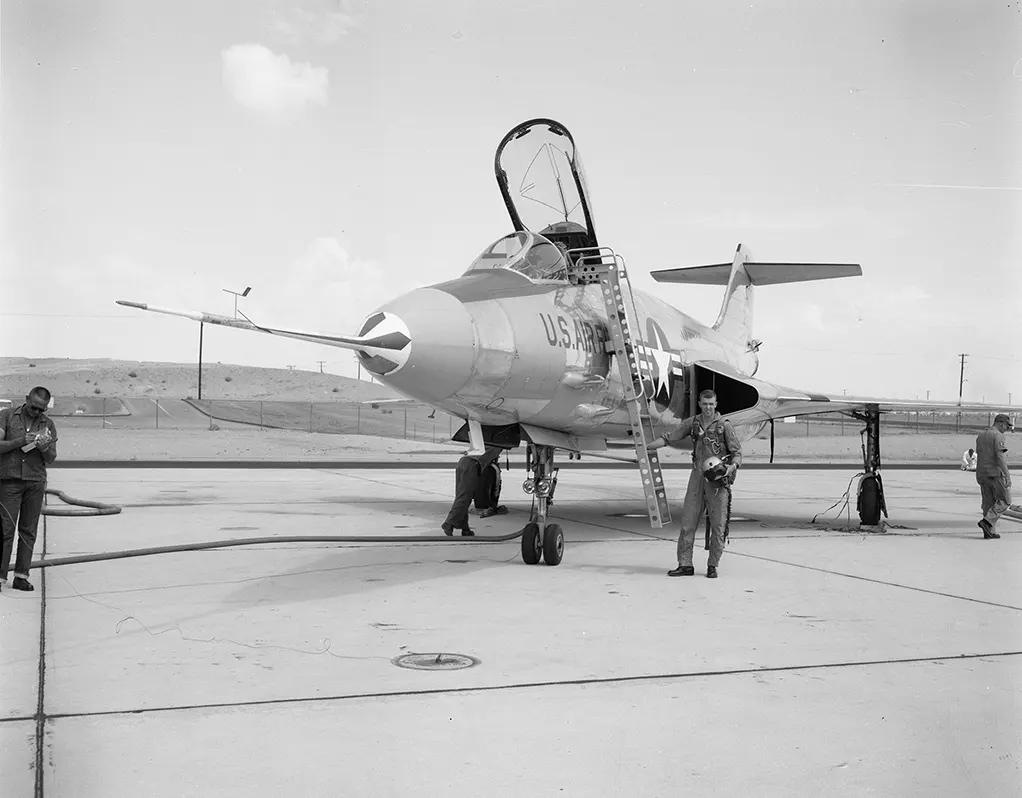 On days where I was not on the ARPS flight schedule, I arranged flights back at NASA FRC to stay current in the C-47H, Aero Commander and T-37B. I also was scheduled at NASA for a C-47A tow of the M2F1 and five chase flights with the T-37B.
After ARP’s graduation I cleared my desk and headed back down the ramp to Flight Research Center. I transitioned within one day with my first flight back home and flew 15 sorties or flights in 5 different types of aircraft through January. A short program was flown utilizing our NASA F-104 to drop a ballute shaped object provided by NASA Langley Research Center. The ballute was the drag device that initially was to provide attitude stability before the main parachute deployment for the Viking Spacecraft landing on Mars. The launch test conditions were around 70,000 feet just under Mach 2.0. I flew chase on Bruce Peterson for nine of these flights. Bruce wore a full pressure suit and I did not, so I had to level off at around 50,000 feet. The drops were made headed out over the Pacific within range of NAS Point Mugu. This Naval base supported aircraft missile testing and could provide radar data on the dropped ballute. Later in my career with Northrop Grumman I had an aircraft maintenance contract covering most of the test aircraft at Point Mugu.
During this early period back to FRC, I flew five test flights in a modified F-104A with an added ventral attached to the bottom of the fuselage. This appendage required takeoff and landing with only approach flaps at 195 knots airspeed to assure not scraping the extended ventral structure on the runway. Various instrumented structural elements were mounted on the ventral to experience the effects of high dynamic pressure. Some of the test articles were structures being developed for the X-20 orbital Dyna-Soar vehicle. The data was thought to be applicable for any later winged reentry vehicle. The highest dynamic pressure test point reached was 744 knots airspeed at 15,000 feet. I could feel the F-104A groaning. I knew that this test condition made for a difficult decision to eject if things went awry. If the aircraft came apart I would have to delay ejection awaiting deceleration to a lower speed. Because after ejection below 14,000 the parachute aneroid would automatically open the parachute resulting in a likely fatality at the test speed and dynamic pressure.
I flew evaluations in our F-104B that had the rear cockpit modified with the addition of monocular vision apparatus that the U.S Army used in tanks. A number of low L/D approaches to judge visual capability through the monocular device to effectively execute the round out and flare for a lakebed landing. This was another approach to handle the very high heating of a Martian entry. The spacecraft would have no windows but rather utilize a deployed monocular system after the high heat region for landing.
Approaching a decision to apply to be an Astronaut, with reference to my flight logbook …. I had enjoyed some 250 sorties or flights during the prior nine months for an average of more than one flight each workday, while involved in six test programs, and flying 14 different types of aircraft. This made the decision very hard as I came to realize later in life that my Edwards flying days were the most enjoyable of my career.
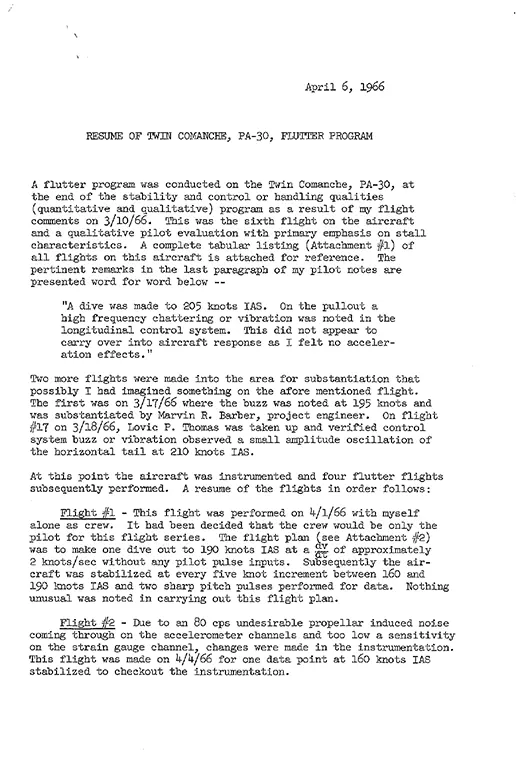
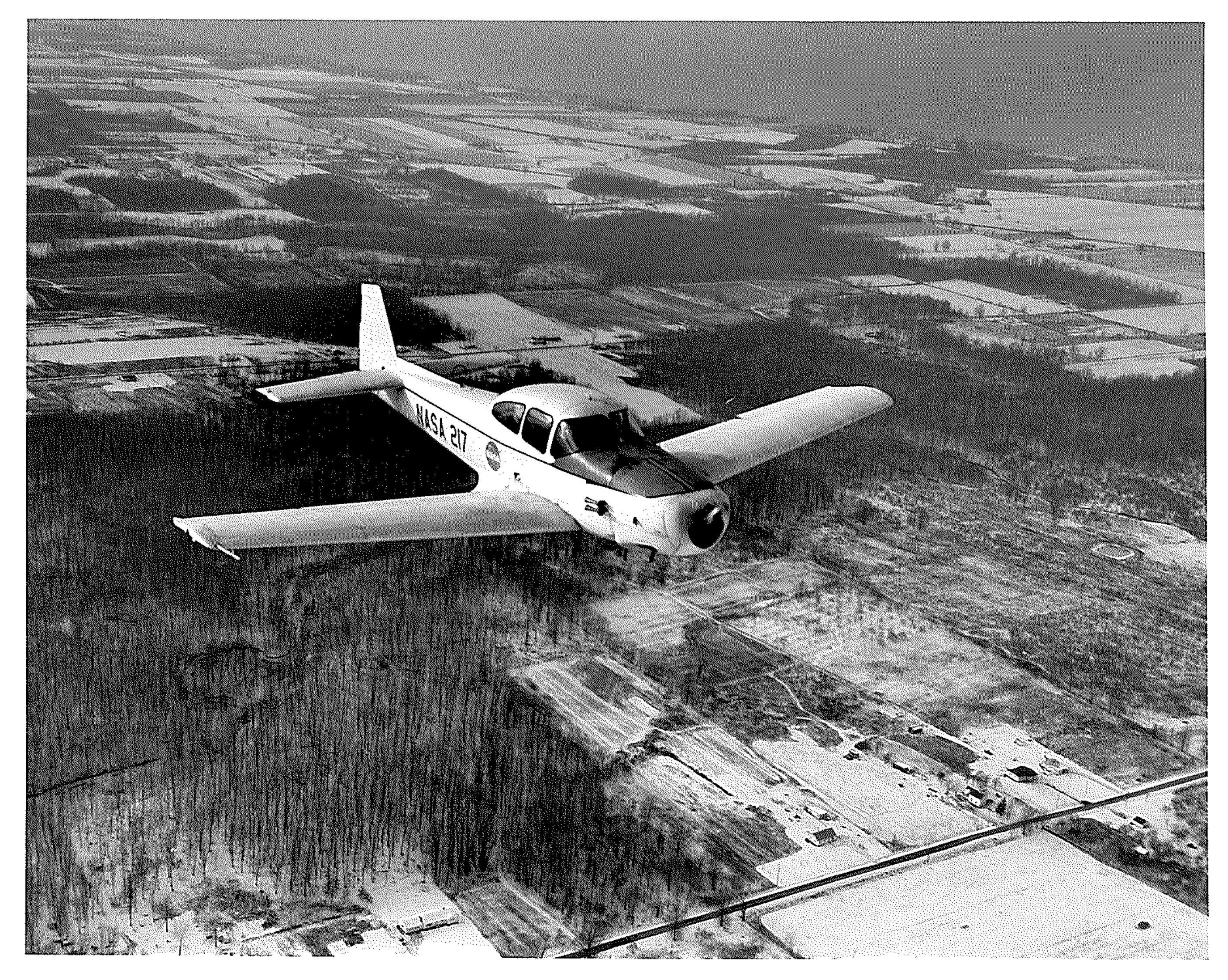
My last flight testing before the Astronaut selection was flutter testing the Piper PA-30 which had been requested by the FAA as an adjunct to the General Aviation Test Program. This was a result of their evaluation from several fatal accidents including one visual observation reported of the tail separating from the aircraft. Dr. Kordes and Test Engineer Russ Barber developed what we thought to be a safe test plan that included a conservative gradual buildup of the velocity for test points planned for each flight. Reviews of the recorded oscillograph data were made after each flight to clear the increase of the test point speed for the next one. I encountered a flutter when I rapped the control yoke below the aircraft certified speed on April 5, 1966. The recorded motion captured on high speed film sort of looks like a manta ray swimming but fortunately the horizontal tail broke internally and did not separate from the aircraft. This YouTube video shows the fluttering horizontal tail motion. This flight was the day after I received the call from Deke regarding my selection … so I could have made history as the Astronaut with the shortest career!
Who:(Left to Right) Jack Enders, Eb Gough, Joe Algranti, Fred Haise, Bill Swann
Download:Image (JPG)
Audio (M4A)
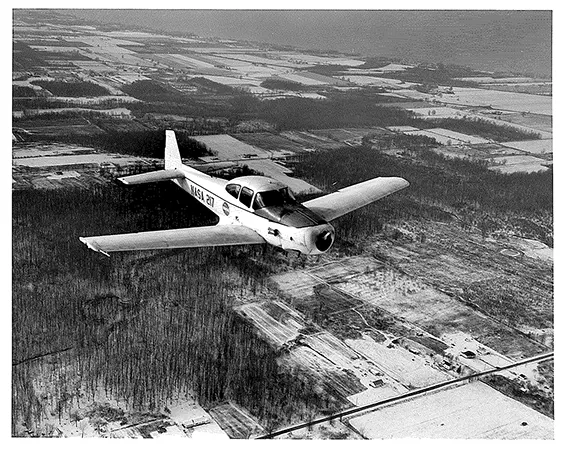
First Flight:September 17, 1959
Total Hours:490.8
Special Note:20 Space Task Group ferry flights.
Download:Image (JPG)
Audio (M4A)
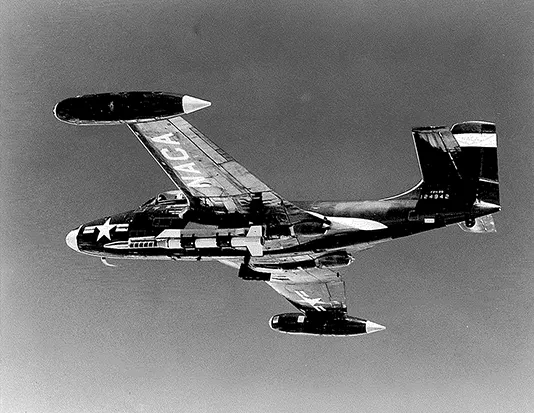
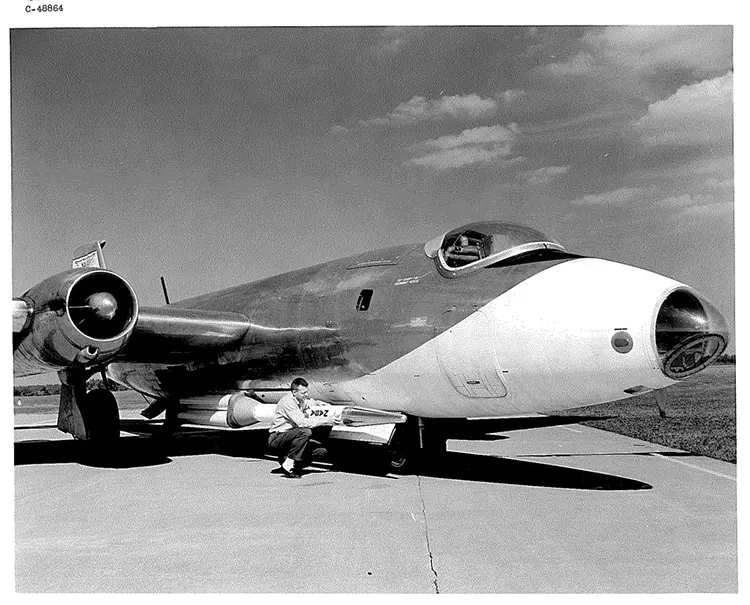
First Flight:November 10, 1959 (B-57A)
Total Hours:88.7 (B-57A & B-57B)
Download:ZIP File (2 JPG files)
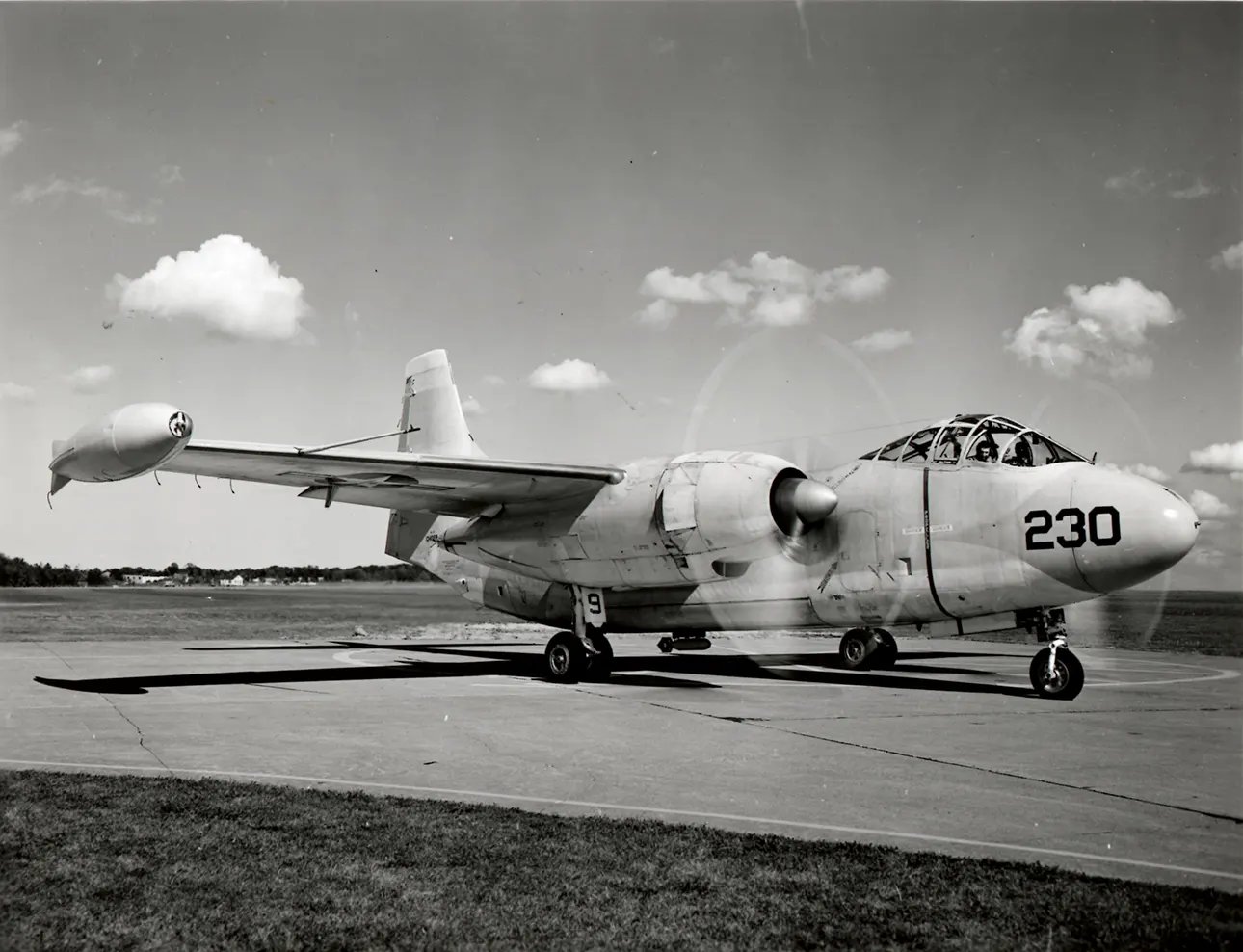
First Flight:May 20, 1960
Total Hours:31.8
Special Note:27 Zero-G Flights
Download:ZIP File (2 JPG files)
Who:(Left to Right) Jack McKay, Bill Dana, Milt Thompson, Stanley Butchart, Fred Haise, Bruce Peterson, Don Mallick, Colonel Jack Kleuver, John Manke, Chief Pilot Joe Walker
When:1965
Where:NASA Flight Researcch Center hangar with the X-15 in the background
Download:Image (JPG)
Audio (M4A)
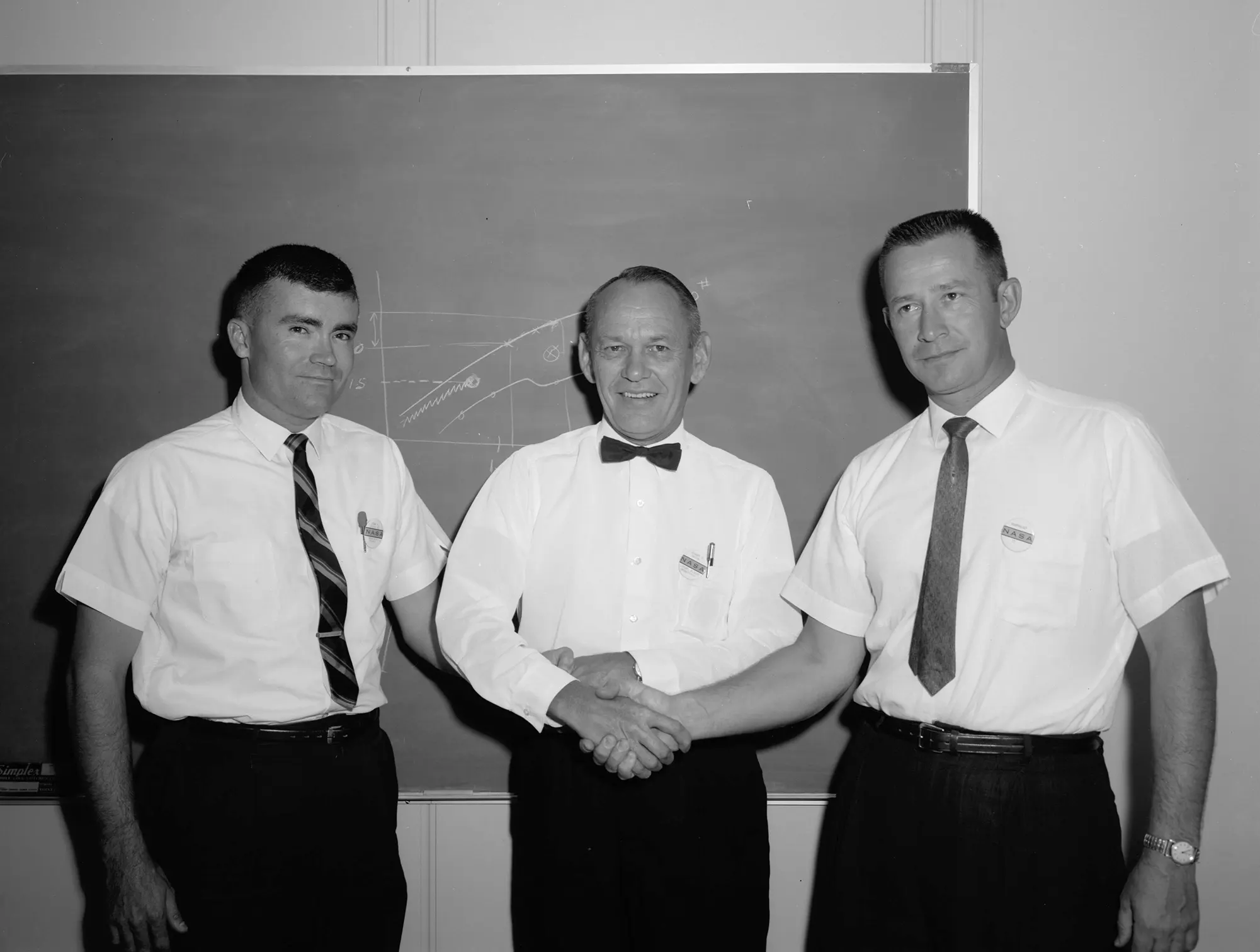
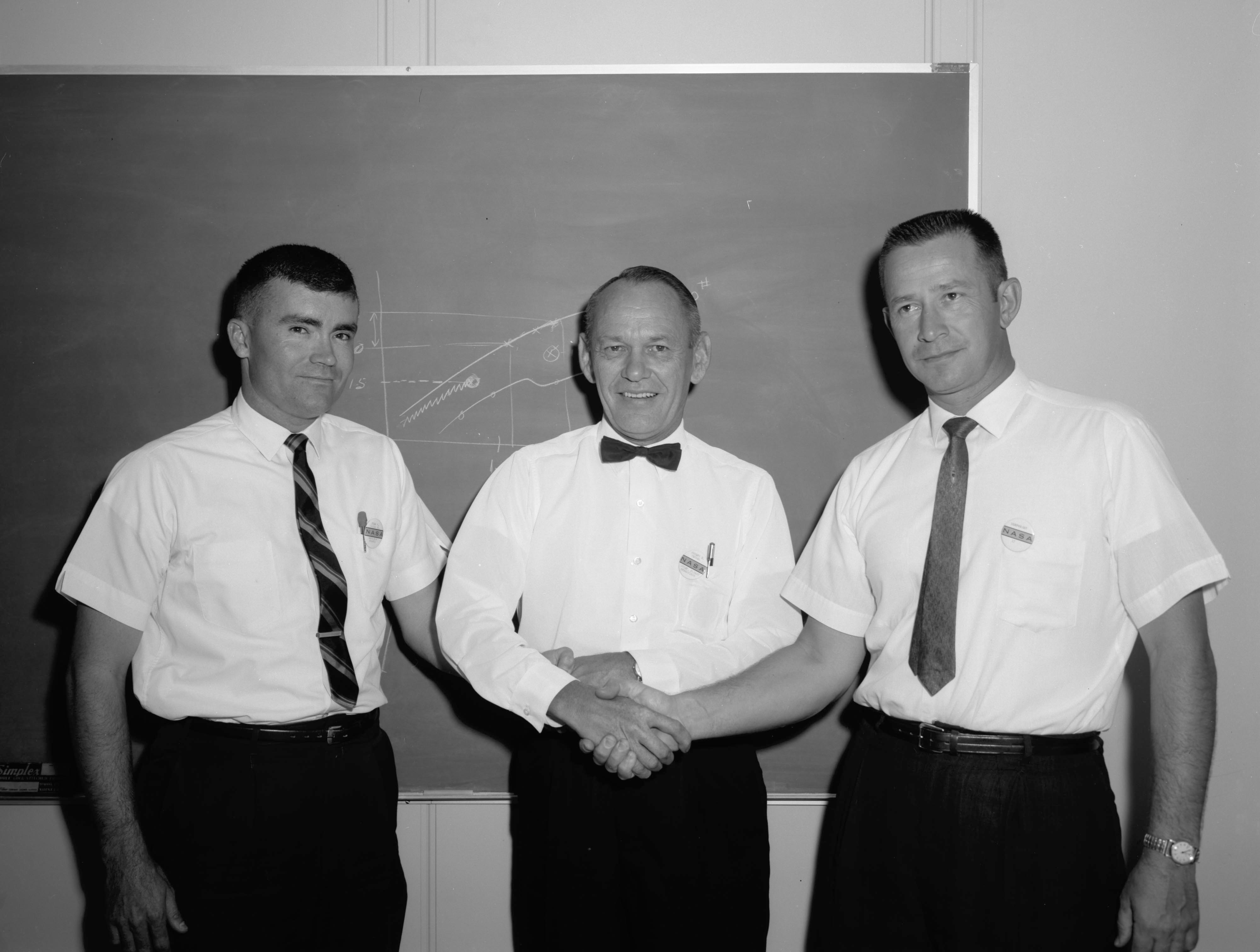
Who:Fred Haise (left), Joe Vensel (center), Don Mallick (right)
Download:Image (JPG)
Don Mallick and I meeting with the head of FRC Flight Operations, Joe Vensel (center), after transferring from NASA LeRC and LaRC, respectively.

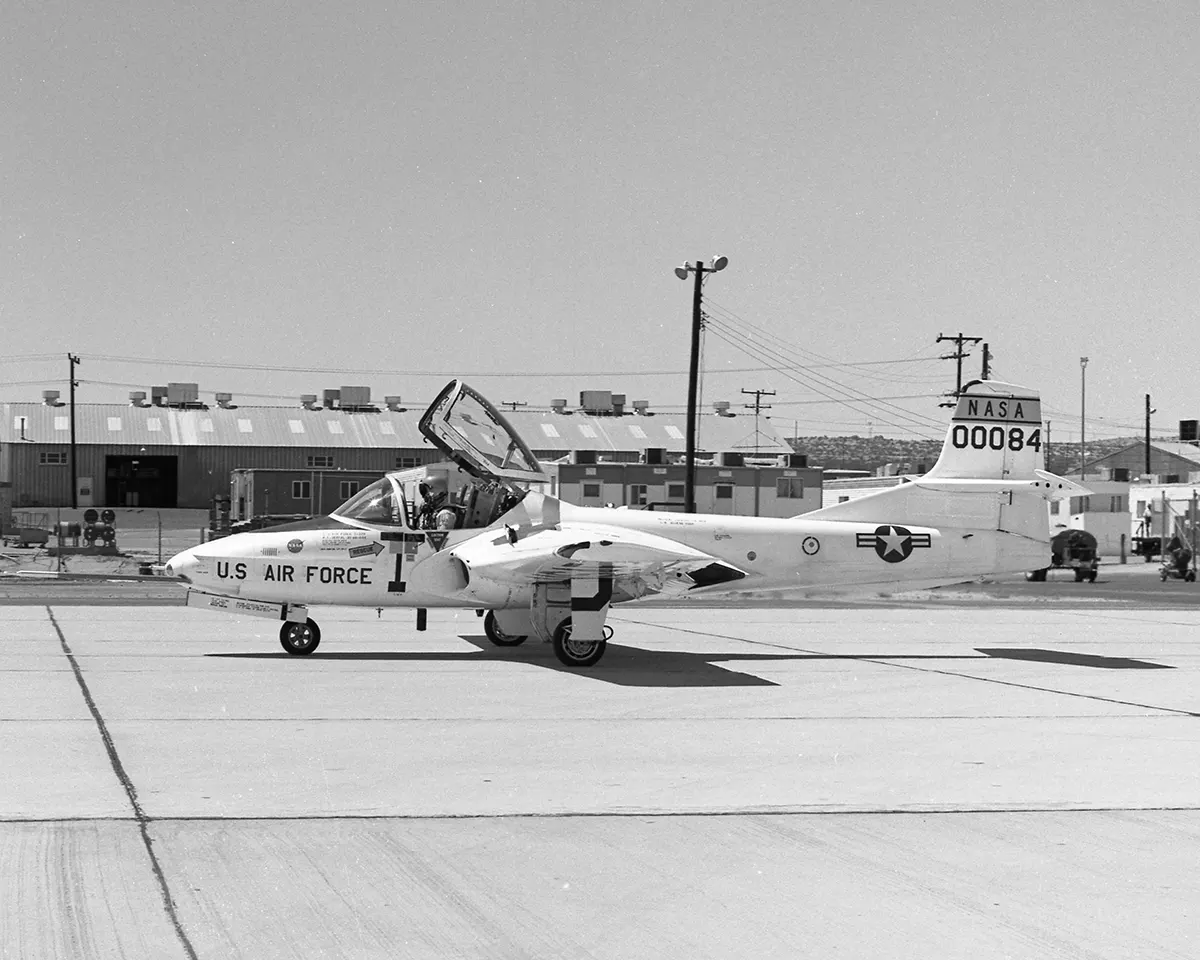
Chase plane with NASA photographer for the M2F1 lifting body flight.
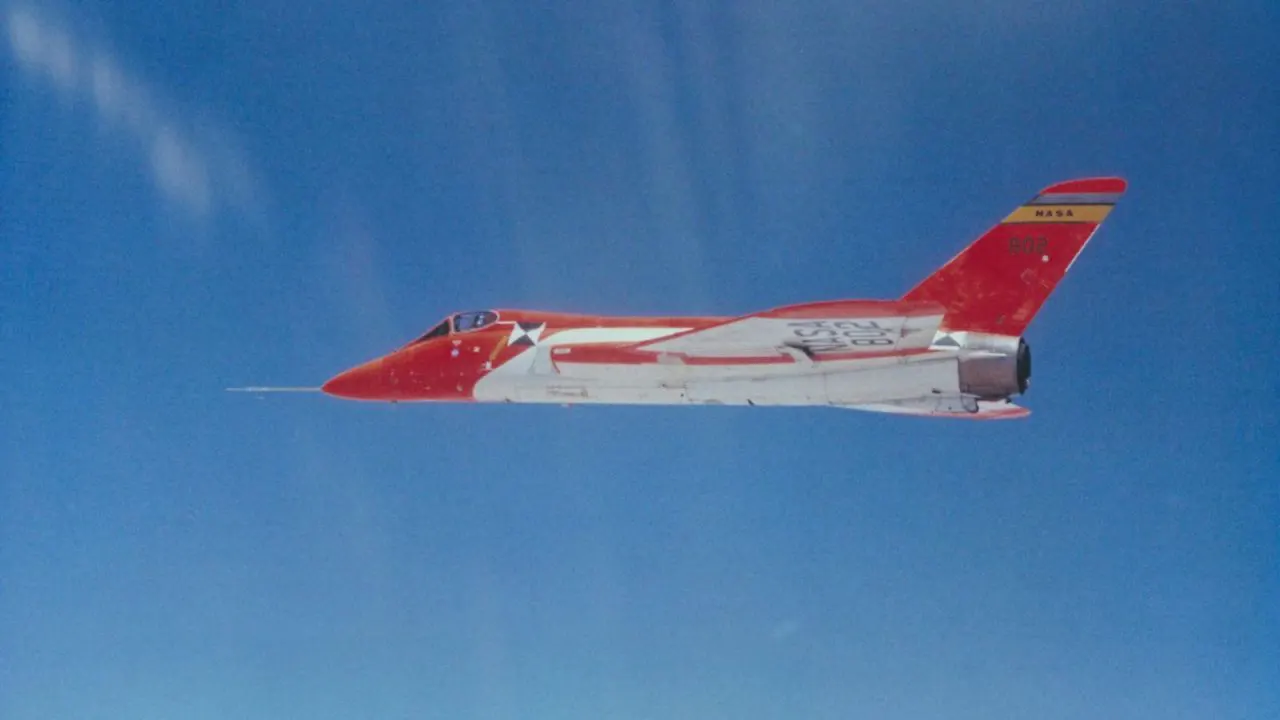
First Flight:May 23, 1963
Total Hours:45.7
Evaluation:X-15 Hi-Range Tracking station checks, Low L/D Project
Download:Image (JPG)
First Flight:May 23, 1963
Total Hours:350.1 (A/B/N models)
Evaluation:X-15 support, X-20 structure tests
Download:Image (JPG)
Audio (M4A)
One of three F-104N's that were brand new and purchased for NASA FRC with mods. They had all the armament (cannon, cartridge containers, etc.) removed and has extra fuel compartments. The first flight that I had in the brand new F-104N was NASA 012 on October 14, 1963
From my log book the first flight in an USAF F-104B, breaking Mach 2 for the first time with Bruce Peterson was May 23, 1963.
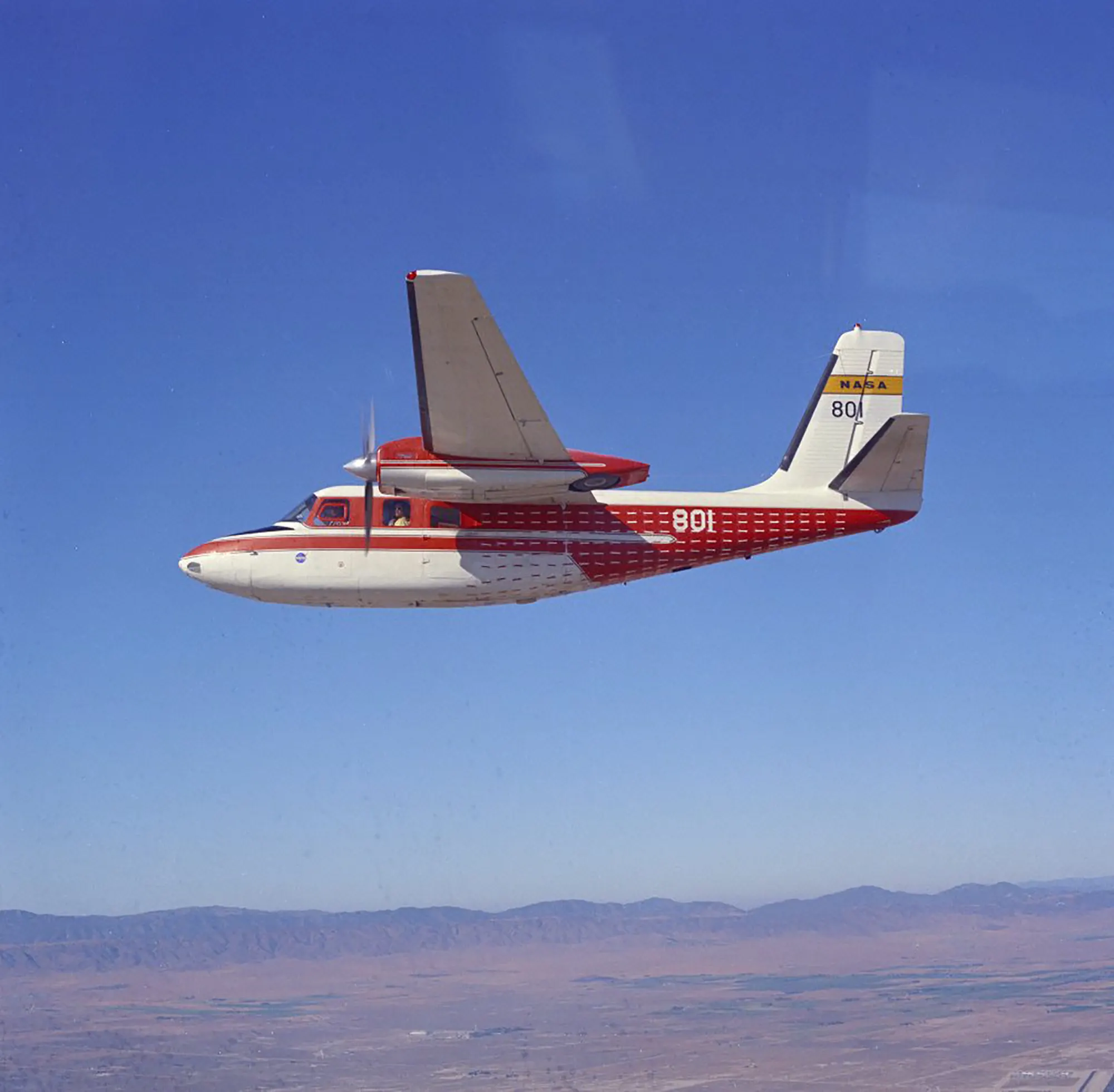
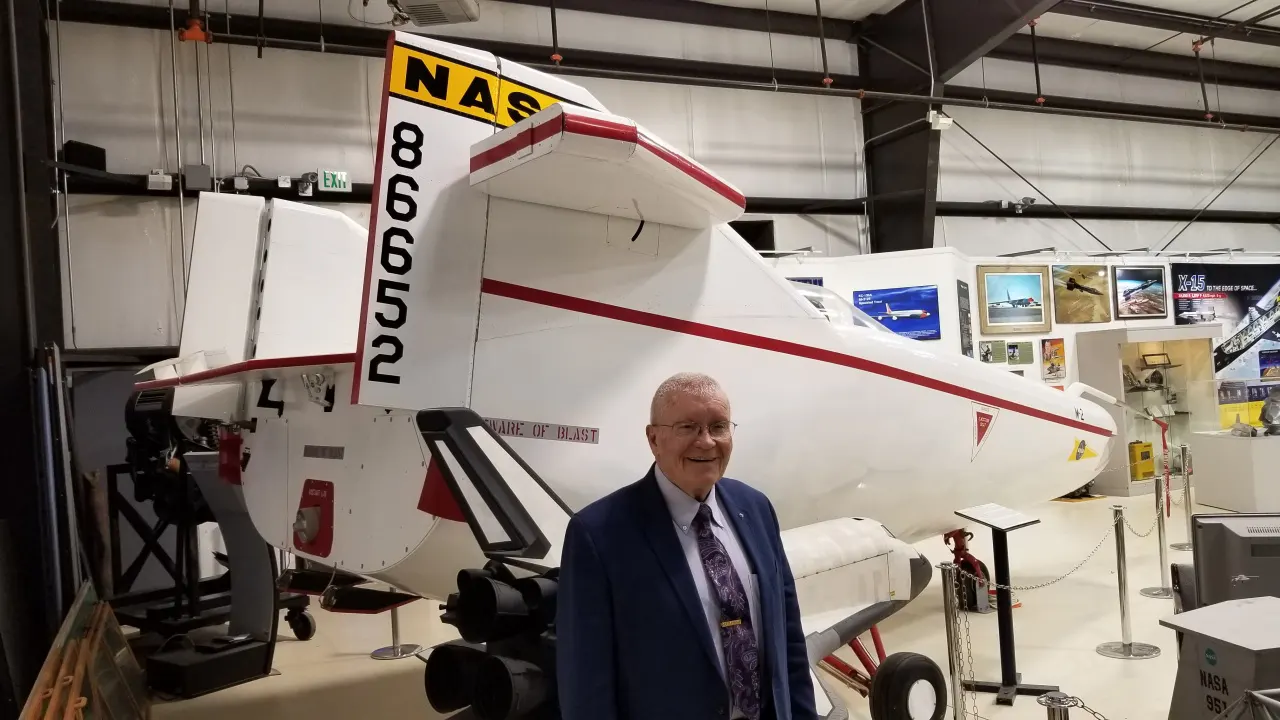
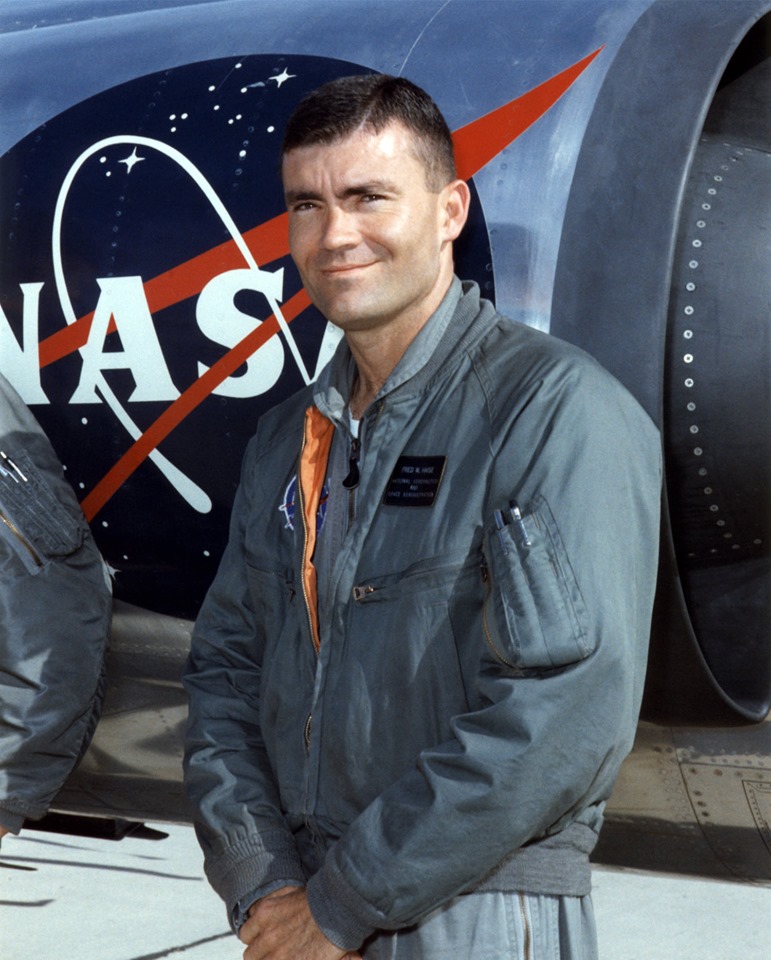
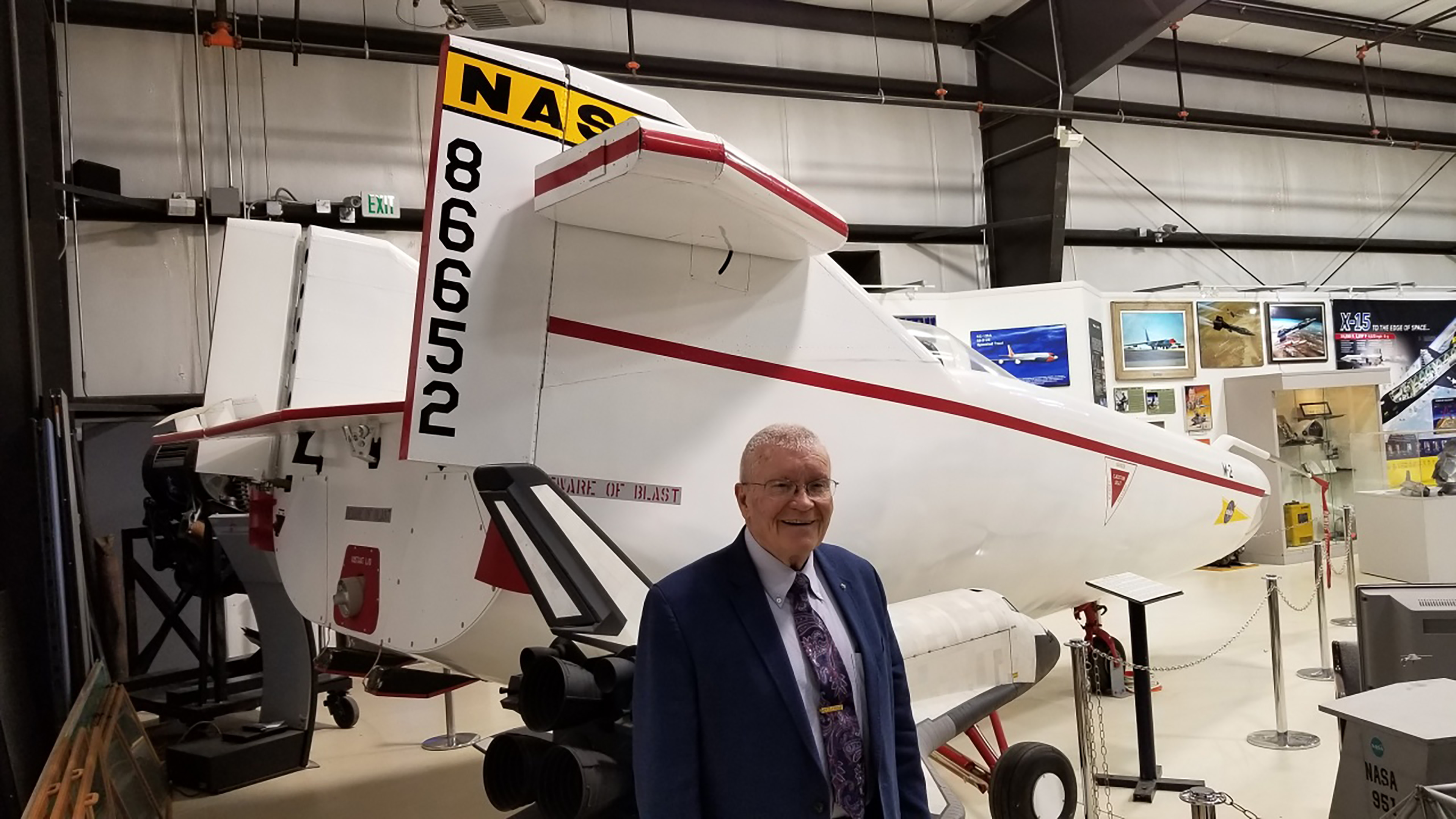
Photo taken of me at the Edwards AFB Museum.
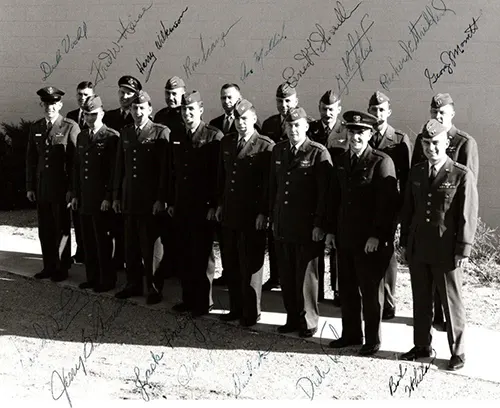
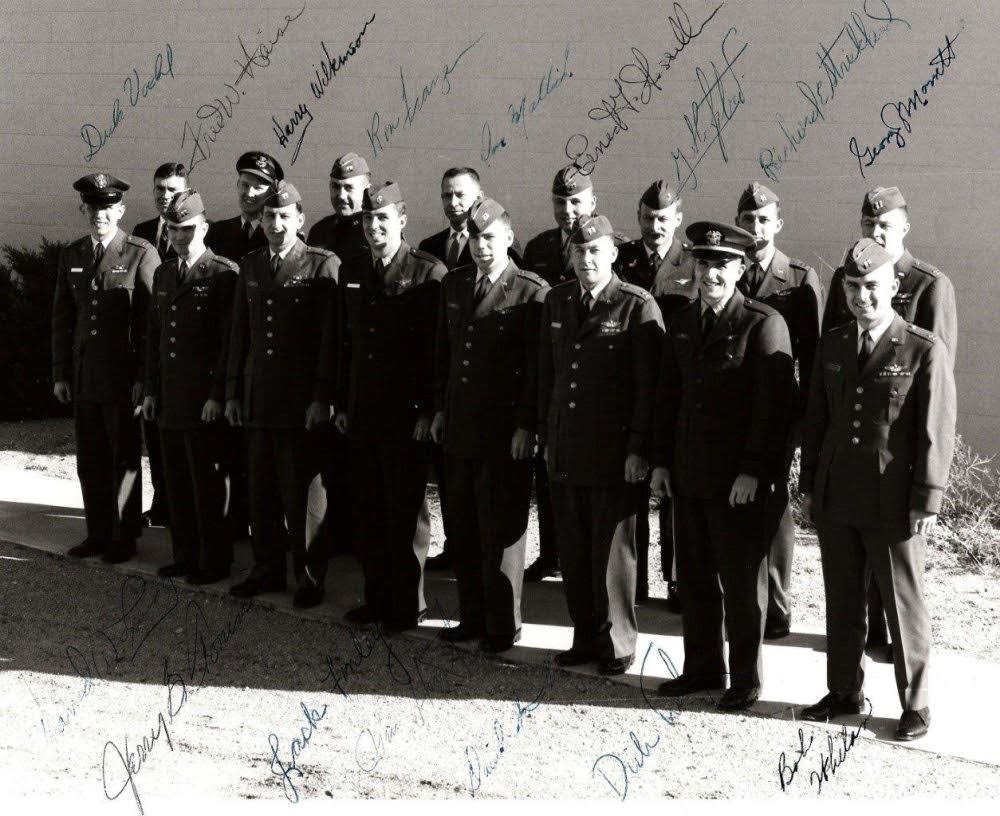
Who:(Back Row/Left to Right) Fred Haise, Harry Wilkinson, Ron Franzen, Don Mallick, Ernie Hasselbrink, Jan Hofstra, Robert Strickland, George Marrett
(Front Row/Left to Right) Dick Voehl, Dave Livingston, Jerry Tonini, Jack Finley, Jim Hurt, Dick Thomas, Dick Truly, and Bob Whelan
When:Early 1964
Where:Edwards AFB, CA
Download:Image (JPG)
Class photo includes those that attended the first six months of the test pilot portion of the school ... including fellow NASA FRC Research Pilot Don Mallick, Harry Wilkinson and Jan Hofstra, plus two foreign military officers.
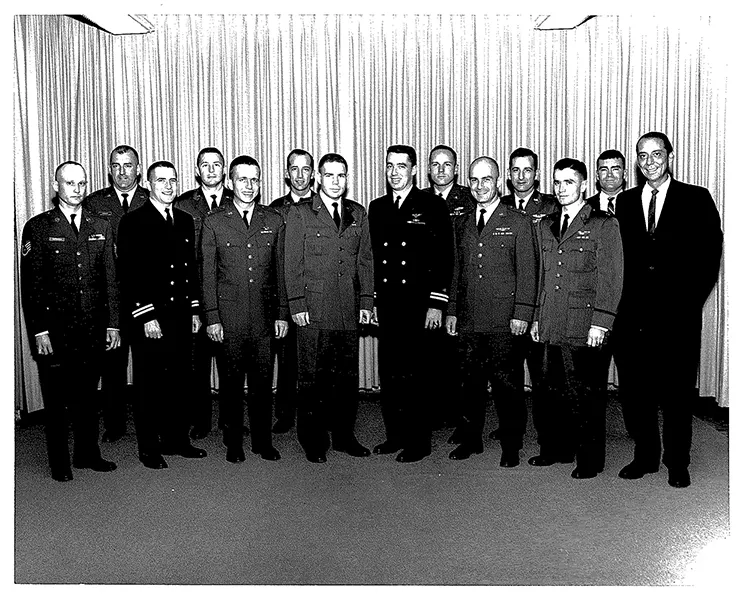
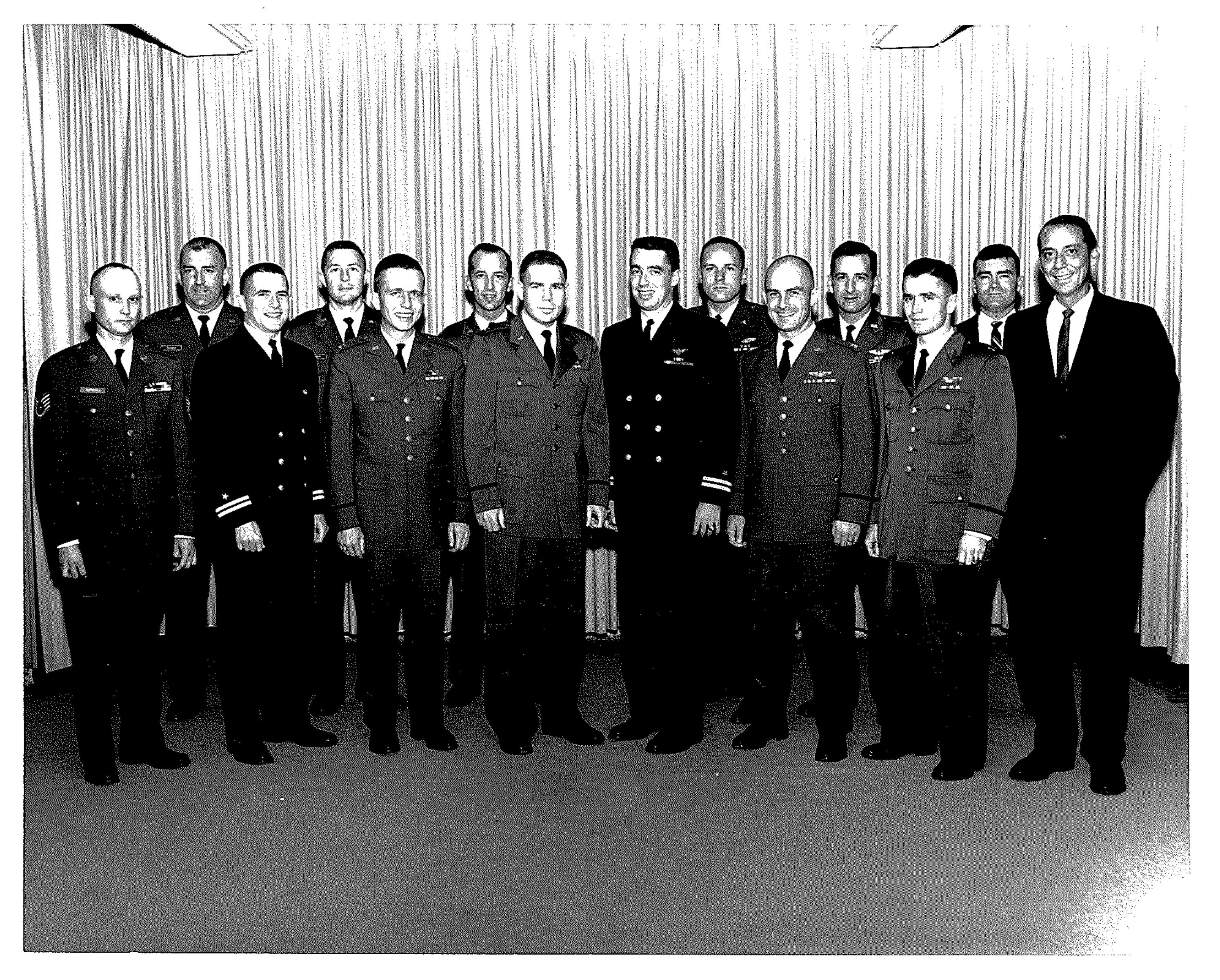
Who:(Left to Right) Uninown Air Force Sergeant, Ron Franzen, Dick Truly, George Marrett, Dick Voehl, Dick Strickland, Jim Hurt, Jack Finley, Ernie Hasselbrink, Bob Whelan, Jerry Tonini, Dave Livingston, Fred Haise, ARPS Instructor
When:Late 1964
Where:Edwards AFB, CA
Download:Image (JPG)
Class photo taken during the second space portion of the school.
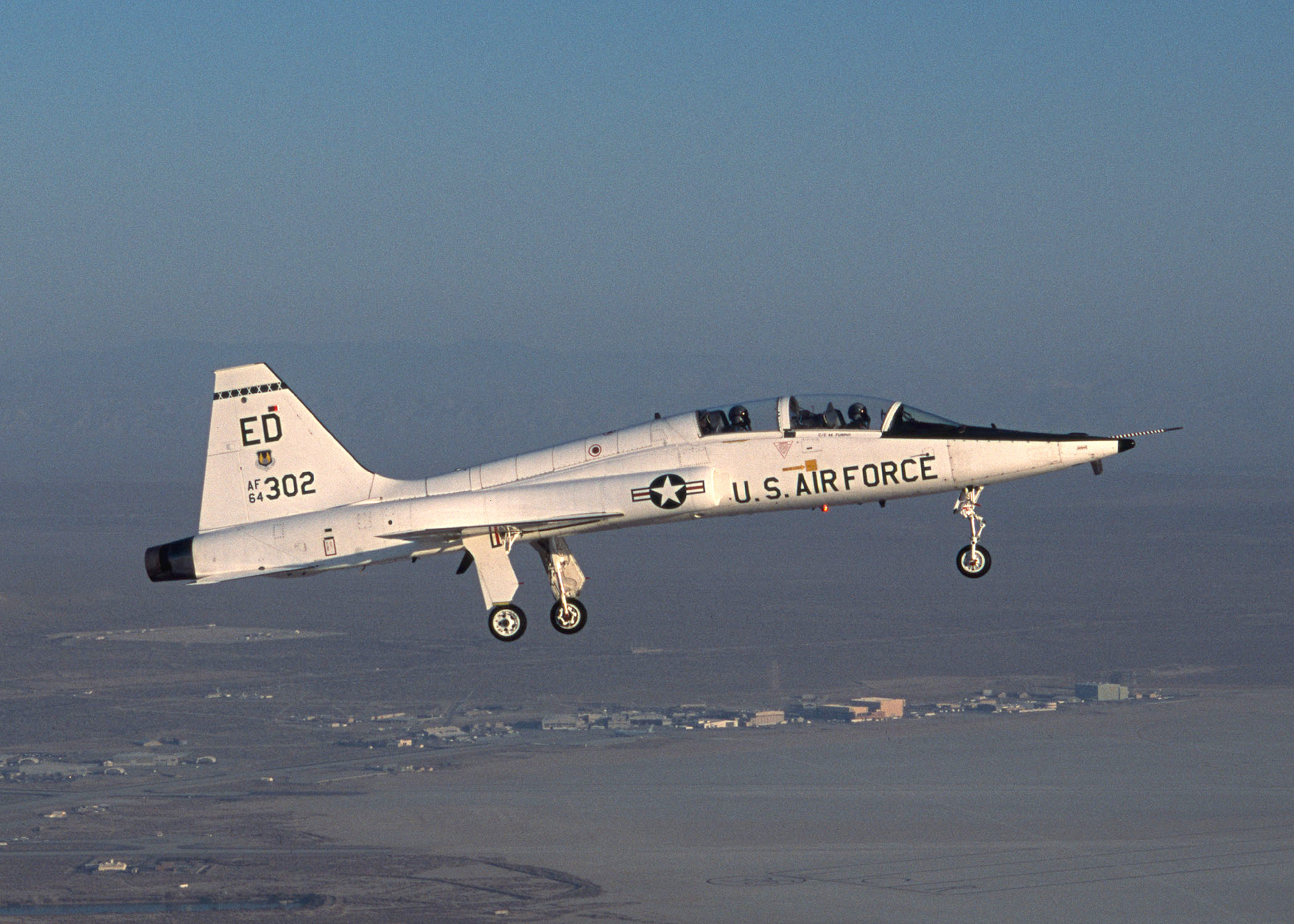
First Flight:January 3, 1964
Total Hours:2859.7
Evaluation:Yaw/roll coupling experience: minus 1.5 G's; plus 5.2 G's
Download:Image (JPG)
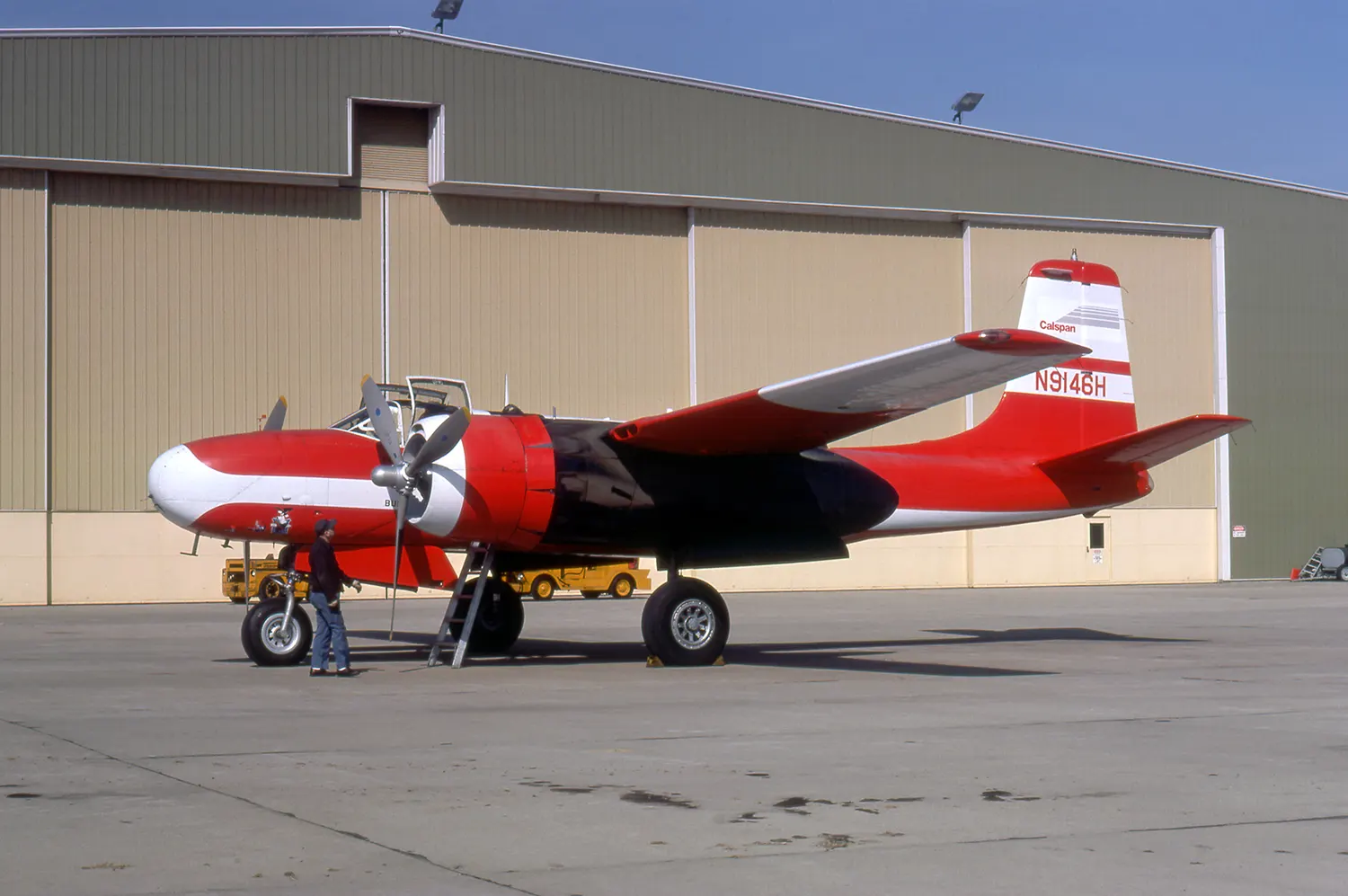
First Flight:May 26, 1964
Total Hours:3.7
Evaluation:Handling quality evaluations
Download:Image (JPG)
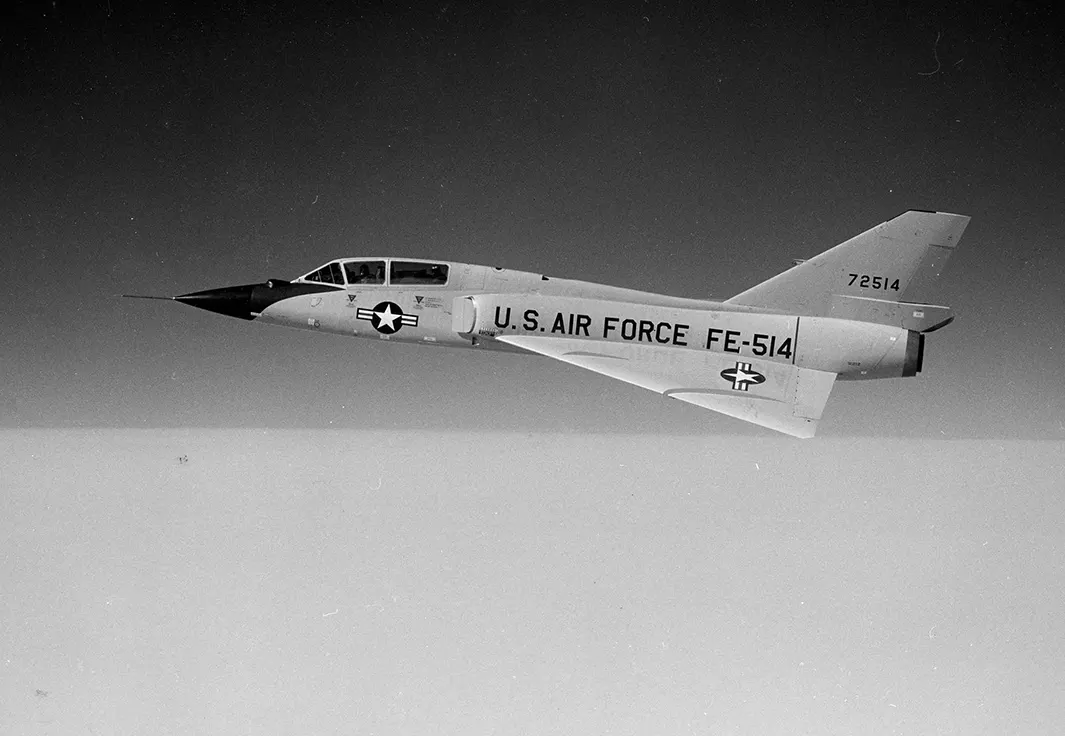
Joe Engle standing next to the aircraft.
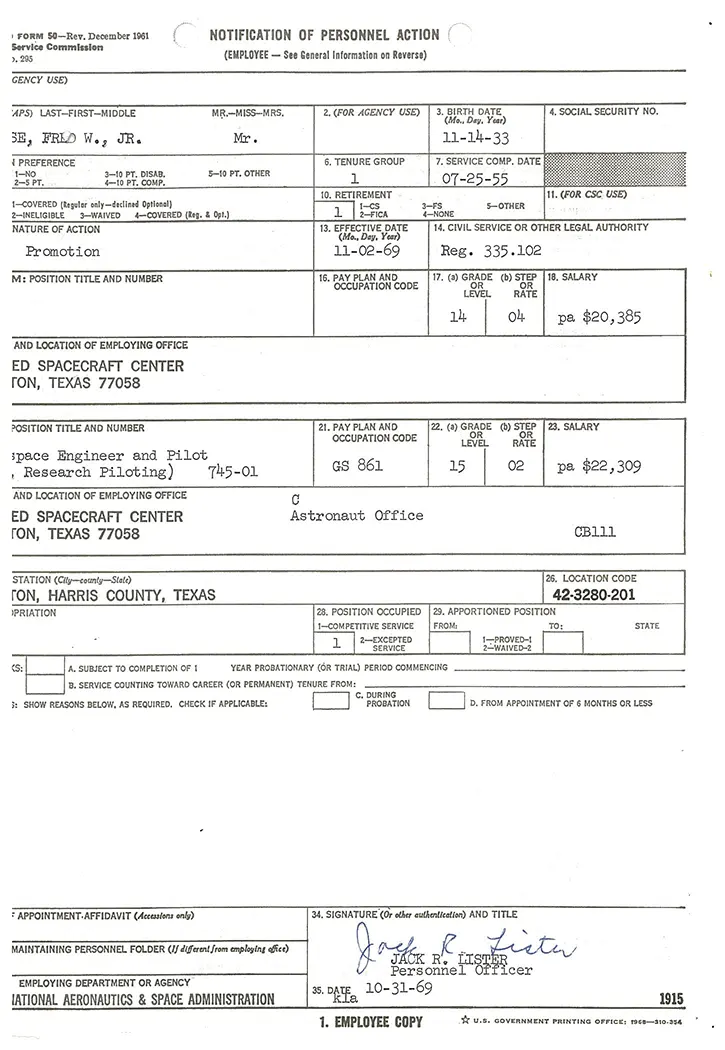
Pages:5
Download:Document (PDF)
Personnel action records covering my 20 year career with NASA, starting with joining LeRC in 1959.
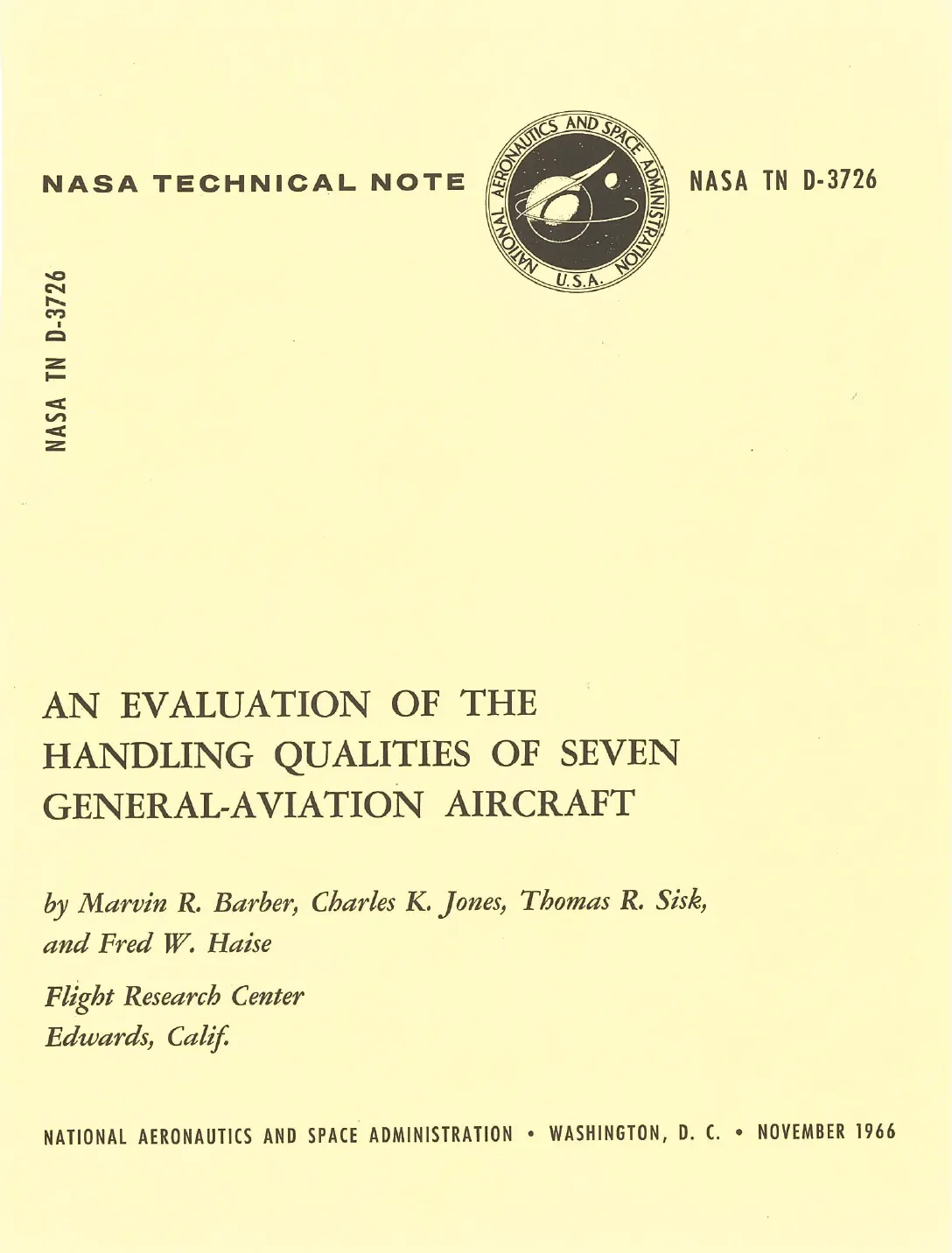
Pages:61
Download:Document (PDF)